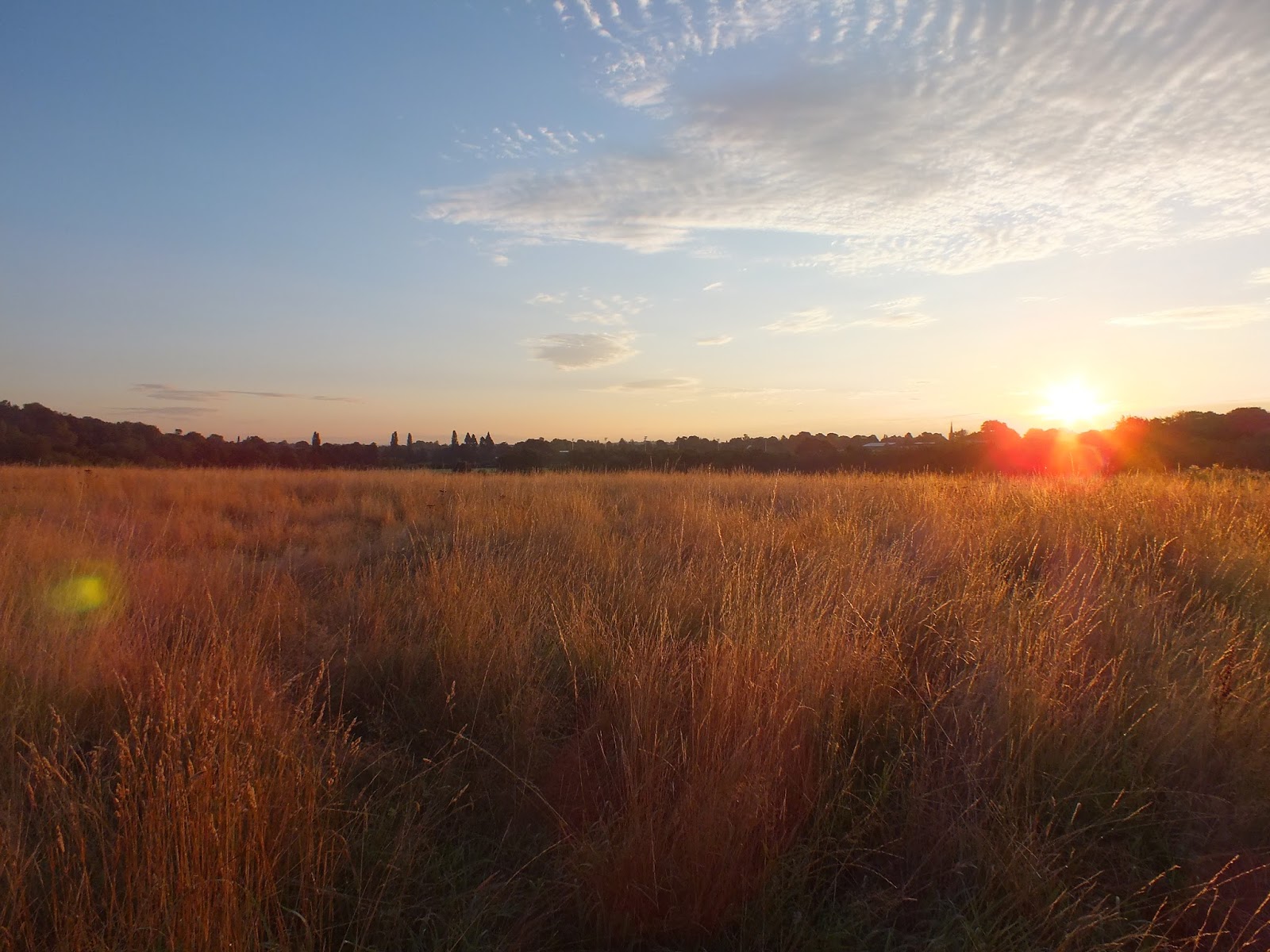
Friday 11/10/13 - Moderate NE, overnight light rain, clearing : Barleyfield "vismig"
A frantic day on the work and home front yesterday meant that I was left to read about the tens of thousands of Redwing that had reached Britain on favourable winds.
An incredible 33,082 were recorded over "The Pinnacle", Sandy, Bedfordshire, in just four and a half hours yesterday morning!! A more modest 2,600 had passed over Black Bank in Staffordshire.
I hit the patch this morning, knowing that winds were more northerly and were likely to halt movements, but still wanted to get some idea as to whether the valley had witnessed some of this event.
It was immediately clear, on arriving at the Barleyfield that birds had got this far West. There was a "movement" of birds west, but aside from 3 groups, the largest holding 35 birds, the rest were grounded birds that were lifting from overnight resting places.
A one hour vismig produced the following, before fading:
Canada Goose 37 SW
Mallard - 5 SW
Cormorant - 4 High SE and 1 soon after heading South - all adults
Black-headed Gull - 65 SW
Woodpigeon - 19 SW - apparently still too early for migrants on the favourable NE
Pied Wagtail - 4 SW
Meadow Pipit - 4 grounded birds, lifted off the Barleyfield and headed SW
Redwing - 150 - c50 on migration West and the other c100 were grounded birds, lifting and heading low West. 55 of these were around the Lower Alders.
Song Thrush - 1 South
Blackbird - 6 coping remarkably well heading West on the cross wind.
Starling - 10 local birds SW and 7 presumed migrants heading West.
MOVING MOUNTAINS NATURE NETWORK (MMNN) -TWITTER FEED
As part of the push towards connecting more people with wildlife, I have now set up a Twitter feed on this blog, that will provide you with updates regarding wildlife events, issues and sightings. They are all my comments or retweets, and will not include personal or provocative opinion from others. Media releases will be shown, where I feel that they are relevant to the understanding and protection of wildlife.
MMNN members who follow us on Twitter will benefit from having their events and causes highlighted on this blog.
I hope that this adds to your experience, whilst visiting us!!
Thank you.

Showing posts with label *Moving Mountains Nature Network. Show all posts
Showing posts with label *Moving Mountains Nature Network. Show all posts
Friday, 11 October 2013

Saturday, 21 September 2013
MMNN - Contributing to Science OR Encouraging Participation ?
I have had it put to me this week that MMNN has to decide which side of the fence it is on.
My vision for MMNN is quite clear: It is so easy to tick both boxes and make a scientific contribution AND engage the public.
I can illustrate this fairly simply:
1. Members such as Council's and wardened reserves, that have the knowledge and experience of data collection, will continue to use a platform such as Living Record, or send data into local recorders and LRC's. They already do an excellent job contributing to Science. My aim here is simply to get as many members as possible onto a common platform, because it will help everyone along the chain in terms of quality and resources. Coordination, repeated surveying and "think-tanks" will help member council's in their tireless pursuit of biodiversity targets and allow them to monitor their performance more easily.
2. Next. The interesting one. What I call "The Second Element": the army of wildlife enthusiasts that hold intimate knowledge of their patches.
To increase the quality and volume of the information hitting the LRC's and NBN, we need expansion of Local Wildlife Partnerships (LWP). This allows a patch of the British countryside to act as a structured "reserve". My life has taught me NEVER to have barriers or say something cannot be done. A central role of MMNN will be to assist in the creation of local partnerships and to identify new sites that require protection and designation, through our army of "bloggers" and "patch" watchers.
It may well be the LWP's that provide the answers, as to why wildlife has vanished in such a short period of time, simply because they venture away from the managed reserves and into our more typical countryside and "wild Britain". The "patch" watchers may prove to be biodiversity's knights in shining armour!!!
3. Now for the worm and what I call the "Third Element". I had a biodiversity officer comment last week that 95% of the population have no intention at all in engaging with wildlife.
Furthermore, my friend's son was asked at school a few weeks ago about his hobbies in front of the class. When he replied that he was a birdwatcher, his supply teacher laughed. Needless to say, after my involvement, her agency have been informed that she is no longer welcome at that school!!
To meet our 2020 biodiversity targets, this attitude has to change. MMNN can embrace participation and education, WITHOUT compromising Science and Conservation. I'm not being funny, but if you ask a School to identify Worms, you will get misleading information!!! It probably would bore most of the kids to death too!!!
If "Citizen Science" goes wrong, you cannot blame those making the records for down-grading the quality of data. Surveys have to be designed carefully from the outset , in order to maximise accuracy of results and the positive influence that it has on the participants.
Is it right that we have more than 80,000 species of wildlife in the U.K? The vast majority of BAP species, don't even appear in the best selling field guides. These have to be recorded only by those with the necessary ability. But I will not accept that MMNN has to be on one side or the other, when the answer is so simple.
Schools can be provided with surveys, which cover easy to identify species. Don't ask them to survey Small White Butterflies, because some kids or even teachers may confuse them with worms, if you see what I mean?
But if every school in Britain performed a survey of male Orange Tip Butterflies, would you disregard the data as useless because it was produced by the 95% of the population that we need on board to save our wildlife? How many future naturalists would this approach produce? How many kids might be influenced by the hunting Kestrel that they see, whilst out on a warm Spring day with their school mates, counting butterflies on their local green space?
We are so lucky to have so many safe LNR's, Wildlife Trusts sites and other reserves and parks in close proximity to schools. We are also blessed to have our State of Nature partner organisations, and I am sure that they can produce a short-list of say 200 species, which are unmistakable and that can be surveyed annually by schools. If I were a science teacher and I had these species on Power Point, the first thing I would be doing with them, on the first week of the academic year, is showing them to my class and allowing them to pick their favourites to study during the year, so that they would already be attached to the project. (I think this area is actually part of the U.K's commitment to biodiversity?). There are a good number of easily identifiable "indicator" species, that if widely surveyed repeatedly, would tell scientists a lot about the strength of ecosystems, locally and nationally, and high-light where they are breaking down fast so that local factors can be identified.
If we make barriers, we shall have barriers!!! Kingfishers are still seen on the section of the River Cole in Birmingham where I first fell in love with nature. I will not allow them to vanish because we failed to rise individually and collectively to the challenges facing the U.K's unique range of wildlife and habitats, by placing obstacles in the way that aren't even there.
Join MMNN today. Together WE REALLY CAN make a difference.
Tuesday, 17 September 2013
Moving Mountains Nature Network - Cheshire, Berkshire and Leicestershire Lead the Way
Just a brief update to say THANK YOU!!!!!!!
Our membership now stands at 125 sites.
For everyone out there who has followed and shared this initiative so far, THANK YOU.
For those that have, or are in the process of joining - together, we really can move mountains for nature.
Special mention has to go to the "bloggers" and "birders" of Cheshire who are banging the drum for this network. These committed volunteers have an intimate knowledge of the State of Wildlife on their local patches, and this can now be utilised through MMNN to halt the decline of species and help the U.K meet it's biodiversity targets.
Special mention, also to council officers in Berkshire and Leicestershire, who have seen MMNN as a way to help meet targets for the protection of biodiversity in their local communities.
Coordinated surveying that breathes life into old data sets and creates new trend data for assessing performance will add to the efficient use of council resources, but will also provide more status and distribution data to the national wildlife organisations that are working so hard to protect and halt the decline in the U.K's wildlife.
Contact from Canada raises hope for sister sites to rise in other countries, so that we can join hands in a peaceful and protective way.
I have started work on local initiatives, involving raising awareness of our cause, through schools.
MMNN has risen and now lets see where this exciting journey takes us all.
Our membership now stands at 125 sites.
For everyone out there who has followed and shared this initiative so far, THANK YOU.
For those that have, or are in the process of joining - together, we really can move mountains for nature.
Special mention has to go to the "bloggers" and "birders" of Cheshire who are banging the drum for this network. These committed volunteers have an intimate knowledge of the State of Wildlife on their local patches, and this can now be utilised through MMNN to halt the decline of species and help the U.K meet it's biodiversity targets.
Special mention, also to council officers in Berkshire and Leicestershire, who have seen MMNN as a way to help meet targets for the protection of biodiversity in their local communities.
Coordinated surveying that breathes life into old data sets and creates new trend data for assessing performance will add to the efficient use of council resources, but will also provide more status and distribution data to the national wildlife organisations that are working so hard to protect and halt the decline in the U.K's wildlife.
Contact from Canada raises hope for sister sites to rise in other countries, so that we can join hands in a peaceful and protective way.
I have started work on local initiatives, involving raising awareness of our cause, through schools.
MMNN has risen and now lets see where this exciting journey takes us all.
Saturday, 14 September 2013
Moving Mountains Nature Network (MMNN) - Month 1 Progress report
 |
| New Dawn Rising: Sunrise over Smestow Valley LNR |
The green area between Oxley and Wightwick has been made famous to conservationists across the UK thanks to the ground-breaking treatise "The Endless Village", which in the 1970's had used it as an example of how a linear park could survive and flourish within a conurbation (the study led to the formation of the first Urban Wildlife Group and helped create the other "green corridor" nature reserves up and down the country). (Reference to Angus Dickie's "Smestow Valley Bird Group 1988-2013")
It is quite fitting, therefore, that the members of the former Smestow Valley Bird Group have served to reignite my passion for wildlife, and put the valley back on the map, as providing the launchpad for MMNN.
After months of planning, the launch of the network on 13th August 2013 filled me with mixed feelings. On the one hand, there was the prospect of a dream coming true. My father's prophecy, that I may be able to change the world for the better, felt like it may actually become a reality. On the other hand, despite my appetite and enthusiasm, there lay negative thoughts that the network would fail to attract support or interest from the outset.
As I write this update, my heart is filled with hope. So many people have taken time to understand this initiative, and respond in a positive manner, because of their open-mindedness, commitment and passion for wildlife.
Customer service staff provided vital support in sign-posting and redirecting mail to those actively involved with biodiversity management. Thank you.
"Patch" watchers have joined the network and promoted it so that their intimate knowledge of their local wildlife sites, is shared in order to discover just why wildlife has vanished at such an alarming rate. Thank you.
Council biodiversity officers have provided in-depth information, constructive comment and support for the network. Any fears that MMNN would be just another data collector have been allayed, as it has become seen that the network will serve to coordinate and repeat surveys so as to breathe life into old data sets and promote the creation of trend data for status and distribution that allows evaluation of whether biodiversity targets are being met at both site and national level. Thank you.
The other concern: that MMNN is repeating the work carried out by the national wildlife organisations, has been removed. The network will actually support these organisations by increasing the uptake of their surveys, and by working towards more coordinated data work in the future that provides them with more trend information to assist future assessments of the State of Nature. Also by working with the "Third Element" through education and media coverage, MMNN will inevitably lead to an increase in the membership for all wildlife organisations.
 |
| MMNN: It's role in the U.K. (click to enlarge) |
My last thank you will go to the great man himself. As a child I was limited to the greenbelt and old mining works around Norton Canes in Staffordshire, but it was Sir David Attenborough that inflamed the desire for conservation and the protection of this beautiful world's wildlife.
With the commencement of surveys for The State of Nature partners, scheduled to start at member sites from 1st January 2014, my focus is now on membership so that we can obtain official recognition.
You really can make a difference and help discover why the nation's wildlife is vanishing, by sharing your knowledge of your "patches", reserves, parks and other sites of importance to wildlife.
 |
| The Great Briton: An impression in concrete at Brandon Marsh Wildlife Trust Reserve in Coventry, to add to the millions of impressions he has made in our hearts. |
If you support the cause, then please join today and thank you as always for your interest in the MMNN initiative.
Tuesday, 3 September 2013
Nagoya: Dream to Reality - The Third Element
In Nagoya, Japan in October 2010, 192 Governments and the European Union met to set out goals and targets to ensure that our natural environment was "resilient" by 2020, so that it can continue to provide the ecosystem services that ARE ESSENTIAL FOR LIFE.
The strategic goals were basically aimed at:
1. Mainstreaming - making people and businesses aware of the values of biodiversity, and to make them aware of how they can conserve it.
2. Pressures - reducing direct pressures on biodiversity and promoting sustainable use.
3. Safeguarding - improving the status of biodiversity by safeguarding ecosystems, species and genetic diversity.
4. Benefits - enhance the benefits to all from biodiversity and ecosystems ( e.g. climate change mitigation and services from ecosystems like water and contribution to health)
5. Knowledge and Capacity - "By 2020, knowledge, the science base and technologies relating to biodiversity, its values, functioning, status and trends, and the consequence of its loss, are improved, widely shared and transferred, and applied"
For these goals and their attached targets to me met, I feel that we have 3 key "elements" can drive us forward and create the formula for success:
The First Element: The Scientists, Defra, Wildlife Organisations and Biodiversity Managers and officers.
The Second Element: The amateur naturalists and wildlife enthusiasts and caring land managers.
The Third Element: The wider population.
So our formula is:
1st element + 2nd element + 3rd element = Targets met under "Biodiversity 2020 Strategy"
The world failed to meet it's targets for 2010, we are now in 2013. The U.K has to, along with every other convention member, submit progress reports by 31st March 2014.
My review, research and feelings gathered whilst creating and launching the Moving Mountains Nature Network (MMNN) are that:
1. The First Element, in isolation is extremely potent in both it's knowledge base and it's enthusiasm to meet biodiversity requirements. In particular, I applaud and gain so much hope from the quality and character of our nation's Biodiversity, Conservation and Parks managers. These people, really are our "generals" in the fight to halt species and habitat decline. Together they are head guardians over our 1500 Local Nature Reserves and also our Country Parks and other green spaces. Around them we should be proud to have Natural England and Defra above and all of the "STATE OF NATURE" partner Wildlife organisations along side them.
2. The Second Element, our amateur naturalists and wildlife enthusiasts? Well we have only to read the latest STATE OF BIRDS report to establish the power of this group who work with the heart and the policeman's notebook. The datasets used in the STATE OF NATURE report covering Bird Species, Mammal road deaths and Butterfly and Moth counts, would have been impossible without the army of amateur enthusiasts.
3. Our Third Element: the wider business and social community in the U.K? Here lies my fear. The importance of the Third Element is easy to understand. On numbers, this element is overwhelming, but more importantly so many of the negative factors that have led to the decline in the U.K, arise from the Third Element. Bank Voles in Smestow Valley LNR are only just recovering from the polution that someone spilled into the Smestow Brook a few years ago, and that is just one tiny example.
For our formula to work we require two things:
1. Unity and co-ordination between The First Element and The Second Element, so that there is great strength from their combining and hence a forward reaction that in the short term may compensate for the weakness or even negative influence from the presence of The Third Element.
2. Regardless, to meet our 2020 and 2050 Biodiversity targets WE HAVE TO MAKE The Third Element a positive and not a negative agent in this reaction, or we shall all fail.
I have three small personal experiences that provide light:
The community spirit and support that came from my charity walk in memory of my son, illustrated that if people understand the cause, they will rise in a strong, positive manner.
As part of my work on the MMNN, I have learned exceptional schemes, where the First Element, combines potently with The Third Element. For example, the council, that works closely with 40 Parishes to encourage participation and understanding in biodiversity work. The officers that set up 24 hour species counts competitions in their community.
Thirdly, on my own patch, by talking to and sharing with the users of my Local Nature Reserve over the last three years, we now have a new group of dog-walkers and health enthusiasts that carry binoculars and display a genuine thirst for wildlife knowledge.
The STATE OF NATURE report CLEARLY tells us we have little time, and a mountain to climb to halt decline and loss.
The following is my own submission and attempt to provoke, thought, comment and reaction, and so, at best, it forms a discussion document, although my heart wants it to be the basis for a plan of action. They are single comments, aimed as spearheads, or if you like catalysts that we may like to add to The Three Elements to allow The Third Element to become a positive agent, and to accelerate the overall rate of reaction, so that the U.K proudly reports in 2019 that it has BEATEN, not met it's biodiversity targets as a nation:
1. There are gaping holes in our datasets. The First Element and the Second Element combined well to monitor fashionable and easy to identify Birds, Butterflies and Moths, but where is our status and distribution trend data for fungi or mini-beasts? I thought that these groups were critical to holding up our ecosystems.
2. I look at the species included on the datasets used in the STATE OF NATURE report and compare them with our JNCC BAP priority species lists. They are worlds apart!!!!!!
3. I got out all of the best selling field guides for wildlife and then laid them alongside the BAP priority species lists (species in heavy decline). With the exception of our ever popular birds, the vast majority of BAP species were absent from the field-guides and reference books. So while thousands of keen nature lovers walk around their patch, there is not one book that they could possibly put in his back-pack that covers all of the species under threat on their site. The RSPB have shown exceptional publishing skills, but it would be so exciting if the JNCC could team up with The STATE OF NATURE partners to create a guide, updated every five years, that concentrates on the accurate identification of say 1200 species that are most under threat in the U.K. A section at the back could include web-links to participate in status and distribution surveys, via the Partners's websites. How strong would our Second Element be if they were armed with this best-seller, created by the teamwork that brings our wildlife organisations together. How strong would our First Element be with the whole nation contributing to surveys that cover the whole food-web and also focus on areas of ecosystems that are breaking down fastest??
4. How can we change our Third Element so that the strange person in green jacket with binoculars is seen as the gallant guardian rather than the gormless geek!!!! Simple!!!
Nature documentaries have an amazing influence and it's no secret that David Attenborough is responsible for my writing this article today. But you need the heart to choose to watch the programme in the first place, and this is the filter that continually converts members of the Third Element into those that form the Second Element.
Repeated addresses to the nation by Defra (or even the leaders of ALL our political parties in union!!), attached to news reports when the whole nation is watching, and even after stand-up comedy shows and late night 18 rated films to explain the alarming decline in our "Natural Capital", and it's impact on business, the economy and human life itself. Can you imagine the effect that this would have on the membership and funding for our nature organisations and local councils?? (GOAL E in the Strategic Plan for Biodiversity 2011-2020)
5. Millions of children could come home to their parents and echo the broadcasts, through learning at school as part of the national curriculum. Science teachers can lead their children from an early age into their local green-spaces to explore the beauty and miracles of nature. Older students can conduct surveys as part of GCSE and A level studies that add to the pool of coordinated studies already being performed by the First and Second Elements.
6. A heavy penal system for those that break the law and damage nature, together with a naming and shaming campaign. Lets alienate those that disrespect our beautiful planet and add the funds derived from penalties to schemes to protect BAP habitats?
Our doubt over the impact of The Third Element has been brought on by ourselves, because The First Element and The Second Element have the power to awaken a force within our nation that will beat all targets and set a fine example to the world.
The Moving Mountains Nature Network initiative is designed to streamline the First Element and the Second Element, whilst influencing the First Element to embrace the Third Element by 31st March 2014.
As soon as the MMNN holds 500 members, it will form catalysts to bring The Third Element into action directly, through education, fund-raising and lobbying: A peoples network but linking all 3 Elements and where the nation becomes the foot-soldiers.
Act now and join the network. Over the coming months, (with their consent) I will be highlighting those that are having the greatest impact on driving this initiative forward.
visit http://www.movingmountains4nature.blogspot.co.uk and add your patch, park or reserve to the network today.
Thank you.
The strategic goals were basically aimed at:
1. Mainstreaming - making people and businesses aware of the values of biodiversity, and to make them aware of how they can conserve it.
2. Pressures - reducing direct pressures on biodiversity and promoting sustainable use.
3. Safeguarding - improving the status of biodiversity by safeguarding ecosystems, species and genetic diversity.
4. Benefits - enhance the benefits to all from biodiversity and ecosystems ( e.g. climate change mitigation and services from ecosystems like water and contribution to health)
5. Knowledge and Capacity - "By 2020, knowledge, the science base and technologies relating to biodiversity, its values, functioning, status and trends, and the consequence of its loss, are improved, widely shared and transferred, and applied"
For these goals and their attached targets to me met, I feel that we have 3 key "elements" can drive us forward and create the formula for success:
The First Element: The Scientists, Defra, Wildlife Organisations and Biodiversity Managers and officers.
The Second Element: The amateur naturalists and wildlife enthusiasts and caring land managers.
The Third Element: The wider population.
So our formula is:
1st element + 2nd element + 3rd element = Targets met under "Biodiversity 2020 Strategy"
The world failed to meet it's targets for 2010, we are now in 2013. The U.K has to, along with every other convention member, submit progress reports by 31st March 2014.
My review, research and feelings gathered whilst creating and launching the Moving Mountains Nature Network (MMNN) are that:
1. The First Element, in isolation is extremely potent in both it's knowledge base and it's enthusiasm to meet biodiversity requirements. In particular, I applaud and gain so much hope from the quality and character of our nation's Biodiversity, Conservation and Parks managers. These people, really are our "generals" in the fight to halt species and habitat decline. Together they are head guardians over our 1500 Local Nature Reserves and also our Country Parks and other green spaces. Around them we should be proud to have Natural England and Defra above and all of the "STATE OF NATURE" partner Wildlife organisations along side them.
2. The Second Element, our amateur naturalists and wildlife enthusiasts? Well we have only to read the latest STATE OF BIRDS report to establish the power of this group who work with the heart and the policeman's notebook. The datasets used in the STATE OF NATURE report covering Bird Species, Mammal road deaths and Butterfly and Moth counts, would have been impossible without the army of amateur enthusiasts.
3. Our Third Element: the wider business and social community in the U.K? Here lies my fear. The importance of the Third Element is easy to understand. On numbers, this element is overwhelming, but more importantly so many of the negative factors that have led to the decline in the U.K, arise from the Third Element. Bank Voles in Smestow Valley LNR are only just recovering from the polution that someone spilled into the Smestow Brook a few years ago, and that is just one tiny example.
For our formula to work we require two things:
1. Unity and co-ordination between The First Element and The Second Element, so that there is great strength from their combining and hence a forward reaction that in the short term may compensate for the weakness or even negative influence from the presence of The Third Element.
2. Regardless, to meet our 2020 and 2050 Biodiversity targets WE HAVE TO MAKE The Third Element a positive and not a negative agent in this reaction, or we shall all fail.
I have three small personal experiences that provide light:
The community spirit and support that came from my charity walk in memory of my son, illustrated that if people understand the cause, they will rise in a strong, positive manner.
As part of my work on the MMNN, I have learned exceptional schemes, where the First Element, combines potently with The Third Element. For example, the council, that works closely with 40 Parishes to encourage participation and understanding in biodiversity work. The officers that set up 24 hour species counts competitions in their community.
Thirdly, on my own patch, by talking to and sharing with the users of my Local Nature Reserve over the last three years, we now have a new group of dog-walkers and health enthusiasts that carry binoculars and display a genuine thirst for wildlife knowledge.
The STATE OF NATURE report CLEARLY tells us we have little time, and a mountain to climb to halt decline and loss.
The following is my own submission and attempt to provoke, thought, comment and reaction, and so, at best, it forms a discussion document, although my heart wants it to be the basis for a plan of action. They are single comments, aimed as spearheads, or if you like catalysts that we may like to add to The Three Elements to allow The Third Element to become a positive agent, and to accelerate the overall rate of reaction, so that the U.K proudly reports in 2019 that it has BEATEN, not met it's biodiversity targets as a nation:
1. There are gaping holes in our datasets. The First Element and the Second Element combined well to monitor fashionable and easy to identify Birds, Butterflies and Moths, but where is our status and distribution trend data for fungi or mini-beasts? I thought that these groups were critical to holding up our ecosystems.
2. I look at the species included on the datasets used in the STATE OF NATURE report and compare them with our JNCC BAP priority species lists. They are worlds apart!!!!!!
3. I got out all of the best selling field guides for wildlife and then laid them alongside the BAP priority species lists (species in heavy decline). With the exception of our ever popular birds, the vast majority of BAP species were absent from the field-guides and reference books. So while thousands of keen nature lovers walk around their patch, there is not one book that they could possibly put in his back-pack that covers all of the species under threat on their site. The RSPB have shown exceptional publishing skills, but it would be so exciting if the JNCC could team up with The STATE OF NATURE partners to create a guide, updated every five years, that concentrates on the accurate identification of say 1200 species that are most under threat in the U.K. A section at the back could include web-links to participate in status and distribution surveys, via the Partners's websites. How strong would our Second Element be if they were armed with this best-seller, created by the teamwork that brings our wildlife organisations together. How strong would our First Element be with the whole nation contributing to surveys that cover the whole food-web and also focus on areas of ecosystems that are breaking down fastest??
4. How can we change our Third Element so that the strange person in green jacket with binoculars is seen as the gallant guardian rather than the gormless geek!!!! Simple!!!
Nature documentaries have an amazing influence and it's no secret that David Attenborough is responsible for my writing this article today. But you need the heart to choose to watch the programme in the first place, and this is the filter that continually converts members of the Third Element into those that form the Second Element.
Repeated addresses to the nation by Defra (or even the leaders of ALL our political parties in union!!), attached to news reports when the whole nation is watching, and even after stand-up comedy shows and late night 18 rated films to explain the alarming decline in our "Natural Capital", and it's impact on business, the economy and human life itself. Can you imagine the effect that this would have on the membership and funding for our nature organisations and local councils?? (GOAL E in the Strategic Plan for Biodiversity 2011-2020)
5. Millions of children could come home to their parents and echo the broadcasts, through learning at school as part of the national curriculum. Science teachers can lead their children from an early age into their local green-spaces to explore the beauty and miracles of nature. Older students can conduct surveys as part of GCSE and A level studies that add to the pool of coordinated studies already being performed by the First and Second Elements.
6. A heavy penal system for those that break the law and damage nature, together with a naming and shaming campaign. Lets alienate those that disrespect our beautiful planet and add the funds derived from penalties to schemes to protect BAP habitats?
Our doubt over the impact of The Third Element has been brought on by ourselves, because The First Element and The Second Element have the power to awaken a force within our nation that will beat all targets and set a fine example to the world.
The Moving Mountains Nature Network initiative is designed to streamline the First Element and the Second Element, whilst influencing the First Element to embrace the Third Element by 31st March 2014.
As soon as the MMNN holds 500 members, it will form catalysts to bring The Third Element into action directly, through education, fund-raising and lobbying: A peoples network but linking all 3 Elements and where the nation becomes the foot-soldiers.
Act now and join the network. Over the coming months, (with their consent) I will be highlighting those that are having the greatest impact on driving this initiative forward.
visit http://www.movingmountains4nature.blogspot.co.uk and add your patch, park or reserve to the network today.
Thank you.
Wednesday, 14 August 2013
Moving Mountains Nature Network
I am pleased to say that after months of preparation and research, this project went live yesterday.
It is basically designed to link as many areas of importance to wildlife as possible, so that co-ordinated recording and surveys can be carried out, in order to support future STATE OF NATURE reports.
However once I have a membership of 500 sites, I will be approaching organisations and individuals, in order to appoint a patron and trustees so that the Network can provide education through schools to create future generations of nature lovers, and also to raise funds for nature protection schemes.
I am also pleased to announce that after sending out my first batches of information to local councils yesterday, I have been overwhelmed with the response that I have received. It seems that there is so much hope from the fact that the authorities are willing to assist so much with promotion of bio-diversity and protection of wildlife.
I have contacted every organisation that assisted with the STATE OF NATURE report so that they are aware of this project.
I am at the stage now where I am looking for all you keen birders and wildlife enthusiasts out there to join the network.
If you watch and record the wildlife at a particular site or "patch" then please visit http://www.movingmountains4nature.blogspot.co.uk
I have included a link to the network from this blog.
The site tells you how the network works and shows you how to become a member.You can choose whether you wish to take part in recording, surveys, education or fund-raising.
As soon as we reach the 500 membership mark, then we shall have the power to "Move Mountains", in order to protect the U.K's amazing wildlife and the project will move on to the next level.
By the end of this week the Smestow Valley blog will be passing the 10,000 visits milestone, since it went live on 1st January this year. Thank you so much to everyone who has visited and supported this blog. We are now number 1 on google when you search for "Smestow Valley". Moving Mountains is, at the moment lost on google, but I hope that by the time that this appears as number 1, then our nation's wildlife will be secure and the species loss shall have been halted, once we have found out exactly what caused such a rapid decline in the last 40 years.
Thank you so much for taking the time out to look at this.
It is basically designed to link as many areas of importance to wildlife as possible, so that co-ordinated recording and surveys can be carried out, in order to support future STATE OF NATURE reports.
However once I have a membership of 500 sites, I will be approaching organisations and individuals, in order to appoint a patron and trustees so that the Network can provide education through schools to create future generations of nature lovers, and also to raise funds for nature protection schemes.
I am also pleased to announce that after sending out my first batches of information to local councils yesterday, I have been overwhelmed with the response that I have received. It seems that there is so much hope from the fact that the authorities are willing to assist so much with promotion of bio-diversity and protection of wildlife.
I have contacted every organisation that assisted with the STATE OF NATURE report so that they are aware of this project.
I am at the stage now where I am looking for all you keen birders and wildlife enthusiasts out there to join the network.
If you watch and record the wildlife at a particular site or "patch" then please visit http://www.movingmountains4nature.blogspot.co.uk
I have included a link to the network from this blog.
The site tells you how the network works and shows you how to become a member.You can choose whether you wish to take part in recording, surveys, education or fund-raising.
As soon as we reach the 500 membership mark, then we shall have the power to "Move Mountains", in order to protect the U.K's amazing wildlife and the project will move on to the next level.
By the end of this week the Smestow Valley blog will be passing the 10,000 visits milestone, since it went live on 1st January this year. Thank you so much to everyone who has visited and supported this blog. We are now number 1 on google when you search for "Smestow Valley". Moving Mountains is, at the moment lost on google, but I hope that by the time that this appears as number 1, then our nation's wildlife will be secure and the species loss shall have been halted, once we have found out exactly what caused such a rapid decline in the last 40 years.
Thank you so much for taking the time out to look at this.
Subscribe to:
Posts (Atom)