Wednesday, 24 July 2013

Pics From an Evening Stroll From Compton to Wightwick Fields

Monday 22nd July 2013

Hottest day of the year!! Calm with no wind at all. Ground rock hard and grasses golden brown.

Birding Highlights:
2 Grey Heron - Wightwick Fields and another near Pool Hall.
Male Sparrowhawk - low over canal from Sand Fields at Compton.
6 Lapwing near Pool Hall.
2 Swift, 7+ Barn Swallow and 2+ House Martin over Castlecroft Bridge (5 Barn Swallow South over Compton Sandfields earlier).
Chiffchaff singing at Sand Fields.
3 singing Common Whitethroat at Sand Fields, one at the Sheep Fields and one on Pool Hall Lane.
Good concentration of Song Thrushes around Wightwick Road Bridge - 3 close territories possibly.
3+ Linnet on wires just South of wightwick Fields.
Singing Reed Bunting just South of Castlecroft Bridge.
Yellowhammer singing on wires in West Midlands near the smallholdings at Castlecroft Bridge with 3+ others nearby.

Other Nature:


Juvenile Black-headed Gull at Compton Park.
Common Blue Damselfly - seen at Compton Lock and Wightwick

Green-veined White Butterfly Castlecroft

Meadow Brown Butterfly - Barleyfield

White Tailed Bumblebee Nest Castlecroft

Male Yellowhammer on wires near Castlecroft Canal Bridge
The only negative on a beautiful evening!!!! A threat to our children, who visit our Local Nature Reserve and a disgusting reminder of how lazy and selfish some people can be. I am so annoyed, having formed so many friendships with the Valley's dog-walkers, to see that someone is letting them down!!!! I have been walking through this area for three years now and I see first hand that 99% of dog-walkers take time and effort to keep the valley clean:


Friday, 19 July 2013

Sightings Update and Advisory Group Meeting

Apologies for my absence on the blog. Work and home commitments are still quite heavy.

Firstly brief high-lights of the few visits I have made to the valley so far this month:

Sunday 7th July 2013

Yellow Wagtail - seen lifting off the new wetland at Compton at 09:00 and calling as it headed off to the NE.

Hummingbird Hawk Moth - a species that is expanding it's range North as a result of climate change. This individual was darting with audible wing-beats between emerging Willow Herb flowers by the canal at between Compton Lock and Prefab Weir. The abdomen pattern showed surprisingly well in flight and its speed was certainly up there with that of dragonflies. It eventually shot off North along the canal.

Coal Tit - family party again seen near Compton Lock.

100's of Garden Chafer beetles flying around the Barleyfield. plus a lot of Ringlet butterflies and Red-tailed Bumble-bees.

3 Buzzard soaring over Tettenhall Ridge.

First 2 returning adult Black-headed Gulls at Compton Park.

Late P.M: Silver Ground Carpet Moth (Xanthothoe montanata) - Compton Rough.

Sunday 14th July 2013

Black-headed Gull - 16 adults at St. Peter's Playing Fields and 27 Adults at the entrance to the Academy at Compton Park.

Swift - good to see 17+ at Newbridge, South of Tettenhall Road. Also a Collared Dove over and a Nuthatch calling near the station, the latter appearing scarcer this year.

Goldfinch - the Thistle parties have started!!! With 4 at the North end of the Barleyfield.

Common Whitethroat - a bit late for breeding but this male has appeared at
Compton Rough and seems to be holding a territory between Compton Lock and Prefab Weir


Insect Life:

Flesh Fly (Sarcophaga carnaria) - attracted to carrion and carcasses.
The female gives birth to live young

Greenbottle (Lucilia caesar) - larvae found in rotting carcasses and sometimes
 attracted to open wounds, making it another of Nature's "cleaners"

Hover-fly (Helophilus pendulus) - sunbathing. These favor wet wooded habitats
 and the males are often seen hovering over water. Their larvae live in stagnant water.

Hover-fly (Syrphus ribesii) - our commonest hover-fly.
These have multiple broods and are a gardeners friend, since their larvae feed on
aphids (Greenfly, Blackfly and Whitefly)

There are 25,000 species of Longhorn Beetle!!!! This one looked like Leptura rubra
 but lacked the yellow lower legs???
Another puzzle!! There are over 500 species of Sawfly in Britain. I have narrowed this one down to one of three species. When I get more time next Month I shall study the pics to see whether it was Tenthredo notha, Tenthredo arcuata or Tenthredo brevicornis. Although this individual is enjoying pollen, it will take small insects and is probably  reliant on clover species for it's larvae to feed on, which the Barleyfield provides- thanks to good management:


OTHER NEWS

Another positive Advisory Group meeting, with so many caring individuals in attendance.

As promised Wolverhampton City Council and Ranger Service will be providing this blog with updates as to any work planned in the valley, in advance of it's commencement. Thank you.

Also, Wolverhampton City Council have offered to work with this blog in order to provide information to local residents and schools, regarding the natural assets of the valley, and also to publicize local events that are organised by the many groups and associations that exist along the valley.

On a negative note, since attending the meeting, I have had a lot of concerned people contacting me with regard to proposals for development of "The Cedars" site at Compton Road.

At the start of August I shall be obtaining more detailed information, including any consultation processes that are planned. I shall provide updates in due course. To this end thank you to the growing number of local residents who enjoy and contribute to this blog and to the protection of the Valley and it's borders.

Saturday, 6 July 2013

The North

Wader Feast


Fri 5th July 2013

Work started on friday morning repairing the wall of lock 20 on the Birmingham Canal,it is expected to take 3 to 4 weeks.The pound below the lock will be drained and the pound above partially drained.The return wader passage is approaching and may!just may attract the odd bird to the newly exposed mud.


Sunday, 30 June 2013

Saturday 29th June 2013

Dry, calm, cloud clearing, light SW – mid-section – Compton to Newbridge including Barleyfield and Compton Park. Early morning

A combination of work and home commitments, together with time spent on “The State of Nature” work, meant that this was only my third visit of the month.

A Chaffinch and Song Thrush were singing near the Compton Road entrance to Compton Park. 2 Greenfinch and 2 Lesser Black-backed Gulls passed over the new school development.

A Blackcap was singing in the coppice by St. Edmunds and a Greenfinch was also in song at Eddy’s Alders. 40+ Woodpigeon were on the top playing fields by Meccano Bridge.

Whitethroat remain in situ at the Barleyfield, with activity at the Shrike Bushes, between Graisley Culvert and The Crossings (with a singing male), and at the top of the field within established territories, although no young were noted.

A Song Thrush was singing at Graisley Culvert, a Swift, Buzzard and 2 Goldfinch passed overhead, and pair of Blackcap were flitting around the NW corner, with young concealed in the hawthorns calling.

At the Crossings, 2 Chiffchaff were singing (one on the junction and another just North along the railway walk).
  
At Compton Rough, 2 Jays flew out from the central Crack Willows, where a Song Thrush was singing.

As I passed the Globe Buddleja’s I couldn’t help but notice that they were attracting dozens of bees on each bush, so I decided to track back later, when it had warmed up to take some photo’s.

At Compton Lock a Grey Heron and my 4th vocal Song Thrush, were noted and family party of at least 5 Coal Tit in the firs were a welcome sight.

At Prefab Weir, a Blackcap was singing by Graisley Brook, with a female nearby, along with a Moorhen and two chicks (about a week old). Nearby in the Crack Willows there was a large Tit Flock, holding over 25 birds, a mixture of adult and juveniles, with 4 Long-tailed Tit amongst them.

If ever you wander what you would get if you crossed a Magpie with a Moorhen, then the answer was on the bank of the canal, just North of Prefab Weir!!!


Another Moorhen with an advanced chick was South of Meccano Bridge. A Song Thrush was singing from the Main Paddock and a Goldcrest was singing beside the canal at the Academy. A Moorhen was quite comically trying to use a four-foot length of stem for it’s nest there, eventually giving up and frantically grabbing at nearby vegetation in frustration. One of the resident Mistle Thrush’s, settled briefly on a conifer top there.

My 6th and final Song Thrush was singing in the Middle Paddock.


At Newbridge only 3 Swift were present, which I put down to the time of day, but I was surprised to see 8 House Martin hawking just above the tree line, up and down the canal, eventually leaving to the North. 2 Coal Tit were calling from the gardens and 2 Goldfinch.

Having walked the whole section of the canal, without seeing young Mallard, Newbridge had two females with 5, and an amazing 11 advanced ducklings respectively.

De ja vu!!! another Newbridge group of 5 young this year,
 but these have a long  treacherous road ahead to survival

I think this mother saw our blog praising the mum
 who raised 5 young successfully here earlier in the month and wanted to beat her!!!
11 at this age is simply brilliant - well done mum, your mothercare vouchers are in the post.
A Blackcap was singing in the Middle Paddock and a Goldcrest was singing from the Railway Walk near the South end of the Main Paddock.

At Meccano Bridge, the first singing Dunnock and Chaffinch of the day were noted, as was a Great Spotted Woodpecker.

To the Barleyfield, where a Willow Warbler was calling from the annex with just 3 Swift, darting overhead. 14 Starling flew South-West off the meadow and another Dunnock was singing by Geoff's bench. A lone Stock Dove flew over - numbers have fallen now that the wetlands development area has been prepared for the pitches to be laid. There were 11 there on 5th June this year.

Before leaving I had a quick look amongst the flowers and found a few clumps of Goats-beard:

Tragopogon pratensis - a lover of morning sun!! -
it usually closes back up by midday and wont open at all when it's gloomy.

Now as the sun was warming, I headed back to study the bees at Compton Rough. A Coal Tit was calling from Alpine Way and a pair of Jay and Bullfinch flew over as I arrived at the lock area. A single House Martin headed South.

The Globe Buddleja bushes really are an asset to the valley: in Winter they support a Finch roost and at this time, they are a magnet to Bees. Since they are in the headlines for all the wrong reasons at the moment, I have provided a gallery just to show how spectacular and varied they can be. It also shows that just because, the scene on the bird front is quiet, there is still loads to record and enjoy in the valley:

Honey bee (Apis mellifera) - domesticated and slim.

Mystery Bee!! - showing characteristics of a
female Forest Cuckoo Bumblebee
(Bombus sylvestris)

Tree Bumblebee species??? - this isnt as easy at it looks

Ahh - Tree Bumblebee (Bombus hypnorum)

OMG!!! - Help!!! White upper and brown lower abdomen - no idea!!!

I know this one!! Tree Bumblebee and Buff-tailed Bumblebee

Note the orange tail contrasting with yellow head and upper abdomen.
A hairy  Early Bumblebee (Bombus pratorum)??
It was quite small, but I'm still not sure!!! Shame on me.

Common Carder Bee- (Bombus Pascuorum)

Southern Cuckoo Bumblebee (Bombus vestalis) - the only species (I think)
that has prominent yellow bordering a white tail

Red-tailed Bumblebee (Bombus lapidarius)
I hope that the above bee gallery serves to show a few things. Firstly just how little we know about our natural world. I am so ashamed that as someone who has scoured the countryside, since I were knee-height to a Doberman, I am unable to accurately identify, record and spot a rarity amongst our local bee population. Secondly how hard must it be for our National Nature Organisations to monitor and protect nature with so few amateur naturalists about who can supply data, other than bird notes!!!! Lastly and most importantly, where is our next generation of nature lovers?? I have been walking the valley now for over three years, and have yet to stumble upon anyone younger than me recording nature (Although this blog has served to identify a few new kids on the block locally). Something has to be done to change this.

Anyway!! Off my soap-box (for now)!!

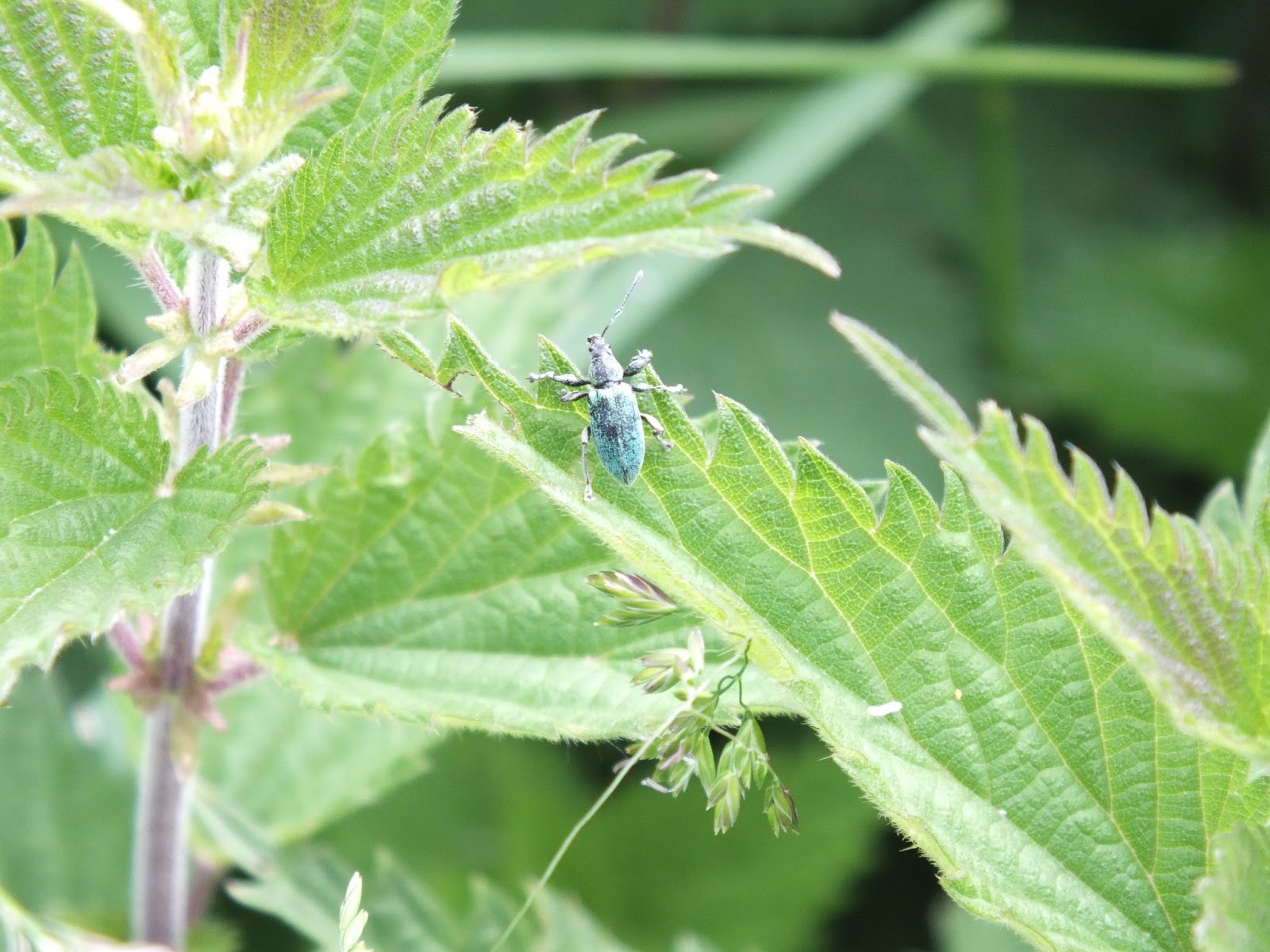
Whilst watching the activity, I noted a small Moth that was present in good numbers on the flowers. The Bees had put me into mini-beast mode and on the way back along the Rough towards the Barleyfield Crossings I found a nice little weevil, with an awkward long name!!!
Phyllobus pomaceus - A Weevil with Blue-green scales on its dark body, that tend to fade with age.

Back to the Barleyfield and before long I noticed that the same small day-flying Moth was present in large numbers. Again shame!!, this undoubtedly would be an important pollinator and I hadn't got a clue what it was. Appeal to the Valley and wider World please....can anyone tell me what it is???

Mystery pollinator!! It looked like a small Hooktip species??
Back through Compton Park, where I learned that 3 Red Fox cubs have been raised near St. Peter's Playing Fields, and then stumbled upon another mystery, which echoed the findings of the "State of Nature" Report - there are hardly any fungi records being compiled and submitted by amateurs, which is alarming given the important role that they play in our eco-systems.

I do know that we do have at least 1 Fungi and funlady in our valley so please help identify what is probably a common lawn mushroom:


It's a sign as to how quiet birding is at this time of year is that my final request is for someone to help identify some poo!!!! This spraint or dropping was actually ON TOP OF the old bridge at Newbridge, ruling out a Bull-Terrier and was quite a size, appearing to be composed of vegetative waste. Any ideas???


Incidentally, the birding wasn't bad - still managed to record 35 Species - not bad for a City Local Nature Reserve during the quite part of the year.

N.B: Please feel free to share by posting a comment. Your comments are not automatically visible, they come through to me for screening first, so any help, views or contributions are welcome.

Please do not pick wild flowers and do not take any wildlife away from where you find them (the weevil shown for example is almost exclusively associated with nettle beds). Thank you.

Friday, 28 June 2013

By 'eck, Drain Swallows are back

and these two are early birds . . .


Dunstall Park


Sunday 23rd June 2013,  cool, early drizzle, clearing later, 09.40 to 10.30.


A few days away, so back to the racecourse to see what if anything is happening in one of the quietest years in three decades locally for breeding and passage bird species.  Barn Swallow flit back and fore from the open stables where their newly fledged youngsters are sheltering from the weather, and adult and juvenile Rook forage on the open grass, near to a group of Canada Geese, the 13 surviving youngsters grazing alongside their parents and other adults.  Gulls are beginning to return, with 14 adult and two immature Lesser Black-backed Gulls and a single second-summer Herring Gull preening and resting near to the geese before flying off towards the city.  At the lake at least ten Coot youngsters of varying sizes either stick close to their parents or are starting to find food for themselves, a female Mallard still shepherds three youngsters nearly as big as herself, and a pair of Gadwall sleep on the water near the island, the male's breeding plumage starting to fade as the summer progresses (these may have been the birds which stayed at the lake from early January until late April this year).  A male Pied Wagtail picks his way along the shoreline, near to a single Lapwing and two Green Sandpiper, the latter very possibly the birds seen at the lake six days ago on 17th.  These waders are among the first species to be seen locally on return migration, leaving their breeding grounds in northern and eastern Europe in mid-summer and flying back to their wintering quarters in Africa and western Europe.  On return passage, they and other species often stay for some time at favoured sites, and in 2010 ones and twos stopped off at Dunstall Park, sometimes lingering for periods of a week or longer, from late June through to early September, with four birds present on one occasion.  These latest visitors fed along the shallow margins before flying to a more sheltered inlet by the island, white rumps showing why their old Norfolk nickname Martin Snipe is so appropriate (other names include the intriguing Yorkshire tag of Drain Swallow, perhaps referring to the bird's liking for relatively small wetland sites such as farm ponds and rural sewage beds).  This is the second-earliest local return record for Green Sandpiper, so good to know that not everything this year has been weeks late.

Dunstall Park        

Thursday 27th June 2013, hot, broken cloud, westerly wind, 10.20 to 11.30.

Weather better, with at least 20 Jackdaw swirling and chacking their way against the wind over the western edge trees, and brief song from Chiffchaff and Blackcap near the canal junction copse.  A Chiffchaff family with at least four youngsters is in a hedge near the old pumphouse (the shale-based racetrack had to be watered regularly during hot spells in the 1990s), and Greenfinch and Common Whitethroat call from lakeside bushes.  There's a pleasant surprise in the form of three Moorhen chicks being fed by their parents along the base of the island, where 50-plus Starling, mostly juveniles, preen and sunbathe.  A single Common Buzzard wings its way heavily low along the canal towards Newbridge, at the same time as two more of its kind sweep up to circle high above Tettenhall ridge far off to the west.  Buzzard sightings will become more frequent now, with youngsters fledging or flying.  They will soon be calling continuously from exposed perches as their parents circle above, drawing them away from the security of their nest sites into the world of the adult raptor.    

(NB.  Dunstall Park is a restricted commercial site.  Access is strictly controlled).


 .


Sunday, 16 June 2013

sunday morning walk to pool hal

set out this morning just after 7 from newbridge along railway to Compton allotments and onto canal at wightwick mill looped back along bridleway from south of pool hall and along lane to return to canal at castle croft bridge. (had done similar route previous sunday.

Great crested Grebe the pair at pool hall have two young three quarter grown.
Lapwing last week pair very agitated around castle croft bridge suggesting young but no sign today
Skylarks a few present and singing maybe 4/5 pairs which is disappointing
Blackcap the most frequently heard songster with 10+ all between tettenhall and wightwick
Whitethroat reasonable numbers 5 singing males and family party at Pool hall
Lesser Whitethroat very well seen gathering food presumably for young birds halfway between Compton and wightwick
Willow warbler also food collecting just beyond the lesser
Chiffchaff only 1 calling bird on each walk
Yellowhammer 2 singing birds by castle croft bridge today and last week

disappointment was only one distant swallow today and only 3/4 last week and no raptors today altho male sparrowhawk in my garden yday was compensation.

Monday, 10 June 2013

Winter Barn Owl Sighting in the Valley


Tom Herrington, who lives near Hordern Road has kindly reported that he saw a Barn Owl flying low across Aldersley Rough towards the canal and racecourse in February this year.

Thanks Tom for your information and for following this blog, and to Steve Nuttall at Belvide Birding for publicising it.

Friday, 7 June 2013

One glimpse, and the grebe is gone


Dunstall Park


Friday 7th June 2013, calm, warm, bright, 09.30 to 10.25.


At last it's summer, warmest day so far this year, so a quick check of the racecourse before the sun gets hot and high.  Barn Swallows are hawking low near their nests in the open stables, and corvids, including juvenile and adult Rook, are feeding on the central grass area, where the Canada Goose creche is grazing, 14 well-developed youngsters with 18 adults in attendance.  On to the lake, where a few House Martin from the Farndale housing estate nests are hawking, and a juvenile Grey Heron, very probably from the Pendeford Mill breeding colony, sits motionless in long grass near the shoreline.  An adult Moorhen chugs away beyond the island, and three pairs of Coot are feeding a total of eight chicks (there are probably more, but it's the devil's own job to count them accurately).  Adult and juvenile Starling take advantage of the falling water level to bathe, splashing vigorously on the shoreline near to a single drinking Stock Dove, and a female Mallard shadows three well-grown ducklings, the only ones of her 10-strong brood to survive.  That appears to be it, when a low, squat shape suddenly appears deep amidst the patches of spiked aquatic grass, a single Little Grebe sitting motionless, in outline against the glittering water.  I'd virtually written them off as a breeding species here this year, despite the presence of two pairs at the lake at the end of April, and this sighting proves nothing.  But these diminutive birds are secretive nesters, so it's just possible they may be breeding after all.  Another look to check where it might go, but too late, the bird's already dived, not a ripple remains.  We'll have to wait and see . . .   

(NB.  Dunstall Park is a restricted commercial site.  Access is strictly controlled).


Wednesday, 5 June 2013

Tuesday 4th June 2013
Another clear sunny day!!! (Light-mod Easterlies)
Mid-section: Compton Park, Barleyfield, Compton to Newbridge

Brief highlights on another evening visit to photograph insects and plant life include:

Great Spotted Woodpecker again on feeding sorties just North of Compton (with soft drumming heard nearby)

An excellent local update from Andy at Henwood Road:
At the start of May, the local pair of Buzzard were air-born over the ridge with at least 6 more circling much higher above them.
The Coal Tits that had been singing and calling at Prefab Weir last month have utilised a nest-box in a neighboring garden.
The Tawny Owls were vocal for most of May on Henwood Ridge, but had quietened down of late.

Well done and thank you Andy.

For those interested I also bumped into a local fisherman who confirmed that Perch and Carp are commonest in the canal, whilst there is also a stock of Bream and Gudgeon, though these havn't been showing yet much this year. We saw what looked like an ornamental " Ghost Carp " which seems to have explained the massive splashes seen and heard around Meccano Bridge.

Thanks go to this gentleman, not only for the info, but also for keeping me stood just North of Meccano Bridge allowing me to spy a hunting female Kestrel - definite highlight for the evening and my first hunting in the mid-section this year for me.

Sorry for the quality, I was on the canal and the Kestrel was over the Shrike Bushes!!!
 My  new camera and scope kit has been ordered at santasaysumustbjoking.com!!!
(double-click image to enlarge)
Goldcrests were singing by Meccano Bridge and near the Tennis Club.

Monday 3rd June 2013
Sunny, Dry, Clear, light Easterlies Evening

Mid-section - Compton Park, Barleyfield and Compton to Newbridge

At last!! Back on the patch. And what a difference: the trees and plants certainly seem to have caught up after such a cold Spring and it was great to see 10 Swift  over Compton Park and the Eastern border of the Barleyfield.

At the Barleyfield itself it was also pleasing to see that 3 pairs of active Common Whitethroat were still holding territories around the site.


3+ singing Blackcap were also present and the Willow Warbler was also singing on the Western border along with a pair of Bullfinch. 4 Greenfinch and Stock Dove passed South West overhead.

The speed, range and movement of the swifts, make it so hard to assess overall numbers and at least nine were darting high over Compton Rough, presumed to be those seen earlier.

On the Rough, the central Willows were certainly providing a valuable food-source as a 2 male Blackcaps tollerated each other, just, to feed along with many Blue Tits and Great Tits.

2 Song Thrush were singing near Compton Lock  and a Grey Heron was perched on one of the conifer tops.


I was taking pictures of Insects and Flowers on the rough, and the extra time spent near the lock served to confirm that a Great Spotted Woodpecker was running feeding trips from the railway line towards the Smestow/Henwood Road area to the West, raising hopes of young being seen in the area again this year. A Jay flew onto the railway walk from the West so hopefully they will be successful in this area too (A family of 5 was seen between Compton Park and The Barleyfield last year).

On the canal, the Moorhen nests appear to be much more conspicuous on the canal and after finding nests with one and two in I was amazed to find a pair just South of Meccano bridge with 7 newly hatched chicks!!!!


Family parties of 4 Long-tailed Tits and 4 Carrion Crow were at The Academy along with another advanced Moorhen chick (With possibly more underneath the overhanging branches??). A Chaffinch and 2 Chiffchaff were also singing along the canal here.

Our early brood of Mallard, have done remarkably well with 5 still together just South of Newbridge, having just lost one over the last month.

At Newbridge, more confusion over Swift numbers. 11 were tearing around the village, but were these the same birds that had wandered up to Compton Park? I feel that they weren't since birds nest at Paget Road and around Compton, but short of synchronized counting at the different sites you can never be sure, given the speed of these masters of flight.I have sat at the Barleyfield and watched groups appearing to move up and down the entire mid-section of the valley in past years.

Sunday, 2 June 2013

Beyond the rising flies, a graceful

grey visitor journeys onwards . . . 


Dunstall Park


Wednesday 29th May 2013, calm, cool, overcast, rain later.
The duller the day, sometimes the brighter the bird, and so it proved as 20-plus House Martin and at least three Barn Swallow hawked at the northern end of the racecourse, presumably following flies emerging from the grass, the damp conditions keeping the insects and birds low, the flocks moving back and forward just above ground level as they fed.  Behind them an indistinct shape, moving at treetop level along the Staffs & Worcs Canal  towards Aldersley junction, small-gull jizz and colour, but wing beats and wing shape wrong, so adjust the bins, and sure enough our first Common Tern for the year is clearly in focus, now altering direction and flip-flopping its way up the Birmingham Canal 21 locks towards the city, grey and white, graceful and lightweight, eventually disappearing beyond the railway viaduct and the Stafford Road.  Always a sight to lift the spirits, the species is an annual but infrequent visitor locally in mid and late summer, sometimes joining flocks of returning Black-headed Gulls on Dunstall Park or following the line of the canal to and from Pool Hall lakes just south of the Smestow Valley.  This one appeared to have a food item hanging from its bill, suggesting it may have been fishing at Pool Hall, along the canal or even at the racecourse lake (in June 2004 a pair stayed for at least three days at the lake, one presenting small fish to its mate and helping Lapwings drive Grey Herons away from the island).  Nesting has been recorded at Belvide Reservoir near Brewood and at Sheepwash Urban Park near Tipton, and with migrating birds late this year, this one may have been following the line of the Birmingham Canal to the latter site.  Whatever its destination, it's given a lift to this topsy-turvy season.  So, on to the lake itself, where Canada Goose youngsters now number 14, two pairs of Coot are feeding a total of seven chicks (at least two other pairs are still sitting), a female Grey Wagtail is picking her way along the shoreline, two Sand Martin are hawking low with at least two Swift and a small number of House Martin,  and our lone Lapwing continues its island vigil (no sign of a male Green Woodpecker which the previous Sunday (May 26th) had called loudly from lakeside bushes before dropping down to feed along the grass margins of the concrete apron below the open culvert of the Smestow brook).
(NB.  Dunstall Park is a commercial restricted site.  Access is strictly controlled.)
PS.   Geoff has asked me to tell you that he heard a Common Cuckoo (sadly now a bird infrequently recorded here and in many other parts of the UK) last Sunday morning (May 26th)  from the Compton barleyfield as it called from somewhere along Tettenhall ridge.  Problems with a broadband connection while he moved house means he's been "off-screen" for more than a week.  If his internet provider gets its act together, he'll be back soon . . .               


.       


Thursday, 23 May 2013

Loneliness of the long-wait Lapwing


Dunstall Park

Wednesday 22nd May 2013, cold northerly wind, dull.

It's bitter for the time of year, and the dearth of birds at the racecourse lake is a true reflection of one of the coldest springs ever recorded.  Some species are now sadly marked only by their absence:  the Mute Swan pair have left, the long-staying Gadwall are gone, and the Little Grebe pair have provided neither sight nor sound for around 10 days.  If they're nesting they're keeping their heads down, but I rather think they've quit the site.  Two of three Coot chicks are still being fed by adults, Canada Goose goslings number ten in total (three broods have now hatched), but there's no sign of any Mallard youngsters.  All in all a sorry state of affairs . . . but then a familiar shape on the island shows that hope can spring eternal.  A single Northern Lapwing stands bravely against the wind, half-sheltered by low vegetation, in a spring vigil that its species has kept here for the last ten years.  Lapwings first appeared at the lake only months after its creation late in 1993, and wintering flocks have visited the site annually ever since.  Numbers have fluctuated, but totals of c.500 and c.600 were noted in February of 2000 and 2002, and display flying in April and May was seen as early as 1998.  It seemed only a matter of time before breeding was attempted, and sure enough in 2002 two pairs nested, with one set of youngsters successfully fledging.  Since then at least one pair has bred annually, but success has eluded them since 2007.  Even so, birds have still turned up in late March and early April, waiting for a mate to appear, so although very late, this one is at least keeping the breeding tradition going.  Perhaps the same bird appeared briefly last month at the lake in one of the few warm breaks in the weather, but with June now fast approaching,  hopes of it pairing and nesting are fading fast. The racecourse operators always keep a 20-metre strip unmown near the lake to encourage the birds to nest, so it's fingers crossed all round.  At least ten House Martin are hawking over the lake, harsh calls from treetops at the canalside oak copse on the western edge of the site suggest young Rooks are being fed at their nests, and to the north a single Common Buzzard hovers Kestrel-like against the wind as it scans the grass slopes by the railway carriageworks for anything that moves.  With things the way they are, I wish it luck . . .           

NB.  Dunstall Park is a restricted commercial site.  Access is strictly controlled.


Sunday, 19 May 2013

Lovely warm SUNSHINE  does it again


sun 19 May 2013            early morning        07:00  -  09:30

mid section     Tettenhall Rd  -- Compton Rd


A pleasant walk in warm sunshine was enjoyed by both birds and me. Plenty of song for a change,nothing unusual species wise, just nice. A Garden Warbler the only scarcity. This species is now an annual event on the Barleyfield, a male usually sings for 3 - 4 weeks in May from the upper western border, fails to attract a mate and then disappears. Fingers crossed this could be the year he strikes lucky.

the counts.  singing birds in ( brackets )

in order of appearance

Blackbird          (5)
Blackcap           11 (10)
Chiffchaff          6 (5)
Song Thrush     (5)
Chaffinch          (1)   unusually low count 
Long tail Tit      5+
Stock Dove       1
Willow Warbler 2 (1)
Jay                    1
Garden Warbler (1)  also seen and heard same place on my last visit ( thur 16th )
Mallard            6     ¾ grown youngsters ( again no sign of mom )
Whitethroat     0    the only exception ( they normally love the warm sunshine )

Saturday, 18 May 2013


Never mind the weather, the Canadas
(and their offspring) are together . . . 

Dunstall Park

Friday 17th May 2013, dull, cool, easterly wind, 10.00 to 11.30am.
Is this still spring, or are we now in summer?  Hard to say in this strange year of confused seasons, the soft new green covering the trees tells us one thing, the relative quiet along the valley, the lack of  bird song, the cold conditions and the comparative absence of migrant species suggests another.  Anyway, down at Dunstall Park lake one species has carried on regardless through those long weeks of cold easterlies and high pressure silences, our old friends (not everyone would use that word) the Canada Geese have sat through it all, patient on their down-lined nests around the shoreline and on the island, and their fortitude has been rewarded . . . the goslings are here.  One pair of adults has two in tow, another pair has five.  Cream-yellow, cute, the youngsters follow their parents up the banks to graze inside the perimeter fence, their heads bobbing above the grass.  It's hard to believe that these engaging feathered toys will grow into the intrusive, noisy and quarrelsome birds that are now an often unwelcome feature at town park lakes, estuary margins, gravel pits and rural nature reserves across the UK.  As more broods hatch, the youngsters will graze together in creche groups, foraging on the open grass in the centre of the racecourse shepherded by their parents and non-breeding adults.  Not all will fledge, some will fall prey to foxes, but in most years the majority will fly, eventually helping to form the impressive skeins of this feral species which honk their way over the valley to and from their late-summer and autumn feeding grounds.  It's not just the geese that have done the nesting thing at Dunstall.  Up-ending amid the spiked aquatic grass are a pair of Eurasian Coot, industrious and attentive, never further than a metre or so from their offspring, three spikey ginger-red headed chicks totally reliant on their parents for sustenance, finding safety amidst the vegetation.  Another three adult pairs are still sitting on eggs, so the numbers of youngsters on the lake should soon increase.  Ever present in the last few weeks have been adult and immature Lesser Black-backed Gulls, flying low over the water or perched on the floodlight pylons, a constant threat to Mallard youngsters.  A fortnight ago there were at least 17 small ducklings, now no more than two are to be seen, still watched by their mother as they feed amongst the spiked grass around the lake edges.  It seems that the gulls, which now breed within the city boundaries, know they're on to a meal ticket, and the ducklings have been their target.  It's better news near the grandstand, where at least two pairs of Barn Swallow are collecting nest material from the exercise ring and carrying it to the open stables where thay have nested for the last six years.  A last look towards the tractor sheds, and a small white-rumped bird flies up from the mown grass to perch on the roof, a male Northern Wheatear, the first of the species to be recorded here this year.  The species is an annual migrant visitor to the racecourse, and in this lean year, it's the first record for the site.  In 1992 a total of 69 birds were reported here on passage, and in 2004 the valley total for spring migrants was at least 78 birds ( 31 were seen at Dunstall Park on April 17th, a day which saw a total of 35 recorded along the valley, equalling the most seen at one time at any West Midland site up until that date).  This year?  Well one bird, I guess, is better than none . . .
                         
(NB.  Dunstall Park is a commercial restricted site.  Access is strictly controlled.)


Wednesday, 15 May 2013


It's a car boot salute as the grey arrow
from Africa drops in on our valley . . . 

Aldersley/Oxley

Tuesday 14th May, westerly breeze, broken cloud, sunny spells, rain later,  09.30 to 10.15.
We're halfway through May, and the northern end of the valley's all but silent when it should still be bathed in birdsong.  Residents such as Greenfinch,  Song Thrush, Goldfinch, Robin, Wren and others are doing their best, but for migrants it's been the quietest spring locally in nearly a quarter of a century.  Whitethroat numbers are way down on recent years, and the few singing Chiffchaff and Blackcap present are are quietening now as pairs begin to nest.  On the same date in 2007 no less than eight different kinds of warbler were heard singing here and on the edges of Dunstall Park just across the canal.  So far this year only half that number of species have been recorded, other migrants including wagtails, chats and thrushes have not shown, and the Smestow Valley's  "rarities fortnight" at the end of April and beginning of May was a non-event.  This sad state of affairs could be down to a combination of a calamitous breeding summer last year and adverse weather affecting migration this spring, and some experts are now forecasting a 50 per cent drop in bird numbers across the UK in 2013.  Whatever the reason, it means visits to places like Aldersley/Oxley with ideal warbler habitats have been made in hope rather than expectation.  So, after half an hour's looking and listening across the sloped grass, it's a reluctant retreat along the Birmingham Canal towpath up towards the Stafford Road and under the blue-brick arches.  Cross over, fleece off, lift the car boot, when for some reason I look up, and over Jones Road and The Downs there's an unmistakable shape against the sky, sharp-winged, lightweight and angular, holding against the breeze, floating lower and hanging before gently settling on a metal rail running along the edge of the railway viaduct parapet.  The small head turns to look downward, white-cheeked with a smudged black moustache, slate-grey backed, yellow-legged and sharp-eyed, its short tail shifting and reddish undertail feathers ruffled as it balances against the updraught, our first Eurasian Hobby for the year.  The jizz is "small Peregrine", but without the menace, without the muscular power, almost gentle by comparison, but arrow sharp, incredibly quick, a bird that can catch a Swift on the wing.  Within a minute or so a resident Crow takes an interest in the visitor, which drops off the parapet and accelerates away to disappear over the racecourse.  Early May is a good date locally to catch this migratory falcon on its return from southern Africa, and this bird may well have been on its way to a breeding site elsewhere in the West Midlands or further north.  Hirundine nest sites along the edge of the Wolverhampton conurbation attract hunting birds during mid and late summer, and they have been seen regularly in recent years checking out the House Martin colony on the Farndale housing estate next to Dunstall Park (I recall watching one on a late-summer afternoon some years ago hawking in a flying-ant swarm over Wightwick canal lock, flashing and twisting amidst a flock of Black-headed Gulls before powering away towards the city).  Yesterday was only the second time I had seen one actually perched in the valley.  Suddenly, a dull day seemed brighter.           


Saturday, 11 May 2013

Unsettled weather but birds settling down

fri 10 May 2013            early morning         light  drizzle

mid section 


With good weather for birders ( unsettled and showery ) if not for the birds ( poor things ) I was expecting some minor rarity this week. I was sadly disappointed,just the usual fare. Things will settle down now as resident and migrant birds are busy nest building,sitting on eggs or feeding young.

Mallard                          6 young near Tettenhall Bridge, unusually moms been missing since at least 30th April.

Buzzard                        Probably one of the resident pair over Compton Field.
Swift                             The odd one over.
Swallow                        1 over Barleyfield.
Herring Gull                The odd one over ( usually a near adult ).
Stock Dove                  2 around the new Wetland area.
Starling                        Small numbers gathering food on Compton Field to take back for youngsters.

Singing birds included:   wren,dunnock,robin,song thrush,blackbird,whitethroat,blackcap,chiffchaff,willow warbler,goldcrest,blue tit,great tit,greenfinch and chaffinch.

And finally a brown staffordshire bull terrier which was first seen by a dog walker on sun 28th April on Barleyfield is still roaming free. I have seen it 3 times,including this morning,always near the trees in the NE corner.

Thursday, 9 May 2013

migrant update

These are sightings from the last 9 days 30 april to today
SWIFT
My first was on Sunday 5th single bird flew north into valley from Pool Hall a second bird ,or maybe 1st doubling back was over the pool 10 mins later.  Two birds were over the station at Tettenhall early on Tues 7th and 2 more over Oxley today.
WHEATEAR
10 were on the cattle field between pool hall and Perton mill farm on 30th April.
YELLOW WAGTAIL
3 (2F&1M) were with the wheatear on 30th
LESSER WHITETHROAT
A bird briefly perched on phone wire just to west pool hall and halfway to road on 30th Apr.
A bird flew across paddock on 2nd May.
WILLOW WARBLER
3 singing birds on30 April 1 NW corner Barleyfield and 2 just north of meccano.  Cross referencing with jeff confirmed different birds. Conspicuously absent since.
CHIFFCHAFF
6 birds contact calling and being very active at north end in morning then 3 singing same spot early afternoon. 3 singing birds paddocks today.
COMMON WHITETHROAT.
the odd bird each visit including one In a garden at the Chase on 3rd and the orchard 1st.
GARDEN WARBLER
Singing bird also seen 50 yds south of the fishing pool at pool hall on 30 Apr.  Another singing bird seen in paddock on 2nd May, both birds attracting attention from male Blackcaps.
Other notable sighting was Little Owl with the pair of Yellowhammers at Castle Croft bridge looking east on 5th may

Wednesday, 8 May 2013

A "Swift" Walk Home Produces Late Arriving migrants!!

Monday 6th May -  Early evening Farndale to Compton Park

A beautiful sunny Bank Holiday prompted me to walk along the valley after work.

I rarely visit the area of the valley between Lock 16 on the Birmingham Canal and The Lupin Field, so I was pleasantly surprised to see good numbers of House Sparrows among the canal side hedges.

On the Farndale Estate, it looked like around 20 House Martins were busy around nest sites.

Goldfinches were singing at Locks 16,17 and 18 and at the Lupin Field, 3 Common Whitethroat, were noted, apparently in separate territories.

2 Blackcap were singing near Lock 20, with a pair of Greenfinch and a vocal Song Thrush nearby.

Rooks were on 2 nests in the NW corner of Dunstall Park (Private land), and on all 4 near Dunstall Water Bridge. A Chiffchaff was singing and presumably it's mate calling nearby.

The Moorhen was still sitting on the nest platform at The Wildside Activity Centre, and at Hordern Road Bridge an adult was with 2 small chicks on the canal.

At Newbridge Wood the Great Spotted Woodpecker was still drumming and calling along with a singing Chiffchaff.

I hadn't eaten so I grabbed a some Fish & Chips and went up to Geoff's bench at the top of the Barleyfield to scoff them, doing a half-hearted skywatch as I filled my belly!!!

At about 8pm, they arrived. The balmy weather seemed to have made them lazier than usual on passage.
At first they headed straight up the valley from the SW, but then they started climbing and circling, with occasional banking and dives: Swifts, 2 of them. They continued to circle and dive, working their way slowly up the valley till they were out of sight with the naked eye.

I finished my meal, happy that though late, these amazing masters of speed were back. I headed up onto Compton Park and as I got up onto the top pitches, I looked up towards the traditional Swift nesting area at Newbridge. To my Surprise, there were now three birds, tracking backwards and forwards, quite high, between. These were certainly behaving as local birds and may possibly have explained the leisurely behavior of the two birds I had seen earlier....lets see.

2 Grey Wagtail headed NE off the Wetland to roost and 3 Stock Dove were on the wetlands.

N.B On Saturday, whilst playing football with my lad and some mates by S. Peter's School, I noted a pair of crows chasing off Buzzard and Sparrowhawk, from their nest site, an adult Herring Gull flew North (causing me to let in a goal!!) and 2 Stock Dove passed over.

Saturday, 4 May 2013

Rattlers, cronkers and super songsters bring sound to this semi-silent spring . .
Aldersley/Oxley
Thursday 2nd May, bright, warm, calm, 09.30 to 10.15.
Back to the rough grass fields at the northern end of the valley, a site that by now should be full of birds and birdsong.  Yet despite the calm, warm conditions bringing song from Goldfinch, Greenfinch, Mistle Thrush, Wrens, Robins, Dunnocks and other resident species, the sounds I'm hoping for just aren't there.  Three Common Whitethroat appear briefly along the field margins, three singing Blackcaps and at least three singing Chiffchaffs (their contact calls show that pairs are already on station) suggest that warbler numbers are increasing, but at least three members of this bird family normally seen and heard in the last week in April and in early May seem not to have arrived.  Then, at last, from a hedge line near lock 19 of the Birmingham Canal, comes a rattling call, identified immediately as one of the valley's most unobtrusive migrant breeders, a Lesser Whitethroat, which flies up to feed among the emerging blossoms high in nearby trees.  Always difficult to pin down, eventually it's located, grey-headed and compact, a smaller and longer-tailed version of a Common Whitethroat, lacking the eye ring and reddish brown wing feathers of its more in-your-face relative.  Breeding numbers in the valley have never been high, and seem to have decreased in recent years.  Let's hope this one finds a mate.
Tettenhall Upper Green
Saturday 4th May, bright, warm, westerly breeze, 10.30am.
Pop to the shops to get a key cut, and as I unlock the car to leave, the sharp, clear notes of the Northern Nightingale cut the air from trees on the green's western corner.  There are cars moving, but the Blackcap's liquid song lifts and flows above the noise of traffic.  There's a seat nearby, so I move towards it to sit and listen to this superb performer.  Yet some of the notes don't seem quite to fit, they're slower, more deliberate, there are gaps between them, and after a few seconds I realise there are two songs involved, two species are singing against each other, the rival bird just as striking and memorable,  a lone Song Thrush high in a tree close by.  Neither of these top-flight songsters will fall silent, neither will gave way to its neighbour, their notes combining in a joyous chorus to tell us that spring is well and truly here.
Smestow Valley
Saturday 4th May,  11.15am.             
Wind down the car window and wait.  A brief shower passes, and high above the tops of the trees sway gently as the squall quietens.  People have told me they're here again, but I need to hear and see for myself.  The valley's only breeding pair, a species that until 2007 was a rare visitor, a bird that, like the Buzzard, seemed to call to us from the west, conjuring the sea cliffs of Wales and the jagged hillsides of the Stiperstones.  Ten minutes pass, silence, then a large black shape sweeps in low behind the treetops, the bird lost to view as it lifts to land at its now traditonal breeding site.  Still silence, then the sound I want, the deep unmistakable "cronk, cronk" of the Common Raven.  If they're breeding they're late, and it's hard to tell if there are young at the nest, but no matter.  They're back.                       


Wednesday, 1 May 2013

A little bird told me about the "WREN" project's latest contribution to the valley!

George Reiss has kindly provided an update.

On Sunday morning (28.4.13), George encountered our Common Sandpiper at 10:00 on the canal by Hordern Road Bridge.

Also he noted that 3 Mistle Thrush were having a scrap just North of the bridge. I have noted a Mistle Thrush territory from Newbridge Tennis Club over to Henwood Road, and would be interested to receive records of singing birds in the Hordern Road area. There are territories at Compton Park and also at the top of the barleyfield.

I have also had news that we should now have an additional Bird and Mammal interpretation board on display at Newbridge Station, compliments of the WREN project.

You will also note, that I have added the website for the Wildside Activity Centre to my list of links. It is amazing just how much this organisation contributes to the valley and education regarding Wildlife and Conservation.