In Nagoya, Japan in October 2010, 192 Governments and the European Union met to set out goals and targets to ensure that our natural environment was "resilient" by 2020, so that it can continue to provide the ecosystem services that ARE ESSENTIAL FOR LIFE.
The strategic goals were basically aimed at:
1. Mainstreaming - making people and businesses aware of the values of biodiversity, and to make them aware of how they can conserve it.
2. Pressures - reducing direct pressures on biodiversity and promoting sustainable use.
3. Safeguarding - improving the status of biodiversity by safeguarding ecosystems, species and genetic diversity.
4. Benefits - enhance the benefits to all from biodiversity and ecosystems ( e.g. climate change mitigation and services from ecosystems like water and contribution to health)
5. Knowledge and Capacity - "By 2020, knowledge, the science base and technologies relating to biodiversity, its values, functioning, status and trends, and the consequence of its loss, are improved, widely shared and transferred, and applied"
For these goals and their attached targets to me met, I feel that we have 3 key "elements" can drive us forward and create the formula for success:
The First Element: The Scientists, Defra, Wildlife Organisations and Biodiversity Managers and officers.
The Second Element: The amateur naturalists and wildlife enthusiasts and caring land managers.
The Third Element: The wider population.
So our formula is:
1st element + 2nd element + 3rd element = Targets met under "Biodiversity 2020 Strategy"
The world failed to meet it's targets for 2010, we are now in 2013. The U.K has to, along with every other convention member, submit progress reports by 31st March 2014.
My review, research and feelings gathered whilst creating and launching the Moving Mountains Nature Network (MMNN) are that:
1. The First Element, in isolation is extremely potent in both it's knowledge base and it's enthusiasm to meet biodiversity requirements. In particular, I applaud and gain so much hope from the quality and character of our nation's Biodiversity, Conservation and Parks managers. These people, really are our "generals" in the fight to halt species and habitat decline. Together they are head guardians over our 1500 Local Nature Reserves and also our Country Parks and other green spaces. Around them we should be proud to have Natural England and Defra above and all of the "STATE OF NATURE" partner Wildlife organisations along side them.
2. The Second Element, our amateur naturalists and wildlife enthusiasts? Well we have only to read the latest STATE OF BIRDS report to establish the power of this group who work with the heart and the policeman's notebook. The datasets used in the STATE OF NATURE report covering Bird Species, Mammal road deaths and Butterfly and Moth counts, would have been impossible without the army of amateur enthusiasts.
3. Our Third Element: the wider business and social community in the U.K? Here lies my fear. The importance of the Third Element is easy to understand. On numbers, this element is overwhelming, but more importantly so many of the negative factors that have led to the decline in the U.K, arise from the Third Element. Bank Voles in Smestow Valley LNR are only just recovering from the polution that someone spilled into the Smestow Brook a few years ago, and that is just one tiny example.
For our formula to work we require two things:
1. Unity and co-ordination between The First Element and The Second Element, so that there is great strength from their combining and hence a forward reaction that in the short term may compensate for the weakness or even negative influence from the presence of The Third Element.
2. Regardless, to meet our 2020 and 2050 Biodiversity targets WE HAVE TO MAKE The Third Element a positive and not a negative agent in this reaction, or we shall all fail.
I have three small personal experiences that provide light:
The community spirit and support that came from my charity walk in memory of my son, illustrated that if people understand the cause, they will rise in a strong, positive manner.
As part of my work on the MMNN, I have learned exceptional schemes, where the First Element, combines potently with The Third Element. For example, the council, that works closely with 40 Parishes to encourage participation and understanding in biodiversity work. The officers that set up 24 hour species counts competitions in their community.
Thirdly, on my own patch, by talking to and sharing with the users of my Local Nature Reserve over the last three years, we now have a new group of dog-walkers and health enthusiasts that carry binoculars and display a genuine thirst for wildlife knowledge.
The STATE OF NATURE report CLEARLY tells us we have little time, and a mountain to climb to halt decline and loss.
The following is my own submission and attempt to provoke, thought, comment and reaction, and so, at best, it forms a discussion document, although my heart wants it to be the basis for a plan of action. They are single comments, aimed as spearheads, or if you like catalysts that we may like to add to The Three Elements to allow The Third Element to become a positive agent, and to accelerate the overall rate of reaction, so that the U.K proudly reports in 2019 that it has BEATEN, not met it's biodiversity targets as a nation:
1. There are gaping holes in our datasets. The First Element and the Second Element combined well to monitor fashionable and easy to identify Birds, Butterflies and Moths, but where is our status and distribution trend data for fungi or mini-beasts? I thought that these groups were critical to holding up our ecosystems.
2. I look at the species included on the datasets used in the STATE OF NATURE report and compare them with our JNCC BAP priority species lists. They are worlds apart!!!!!!
3. I got out all of the best selling field guides for wildlife and then laid them alongside the BAP priority species lists (species in heavy decline). With the exception of our ever popular birds, the vast majority of BAP species were absent from the field-guides and reference books. So while thousands of keen nature lovers walk around their patch, there is not one book that they could possibly put in his back-pack that covers all of the species under threat on their site. The RSPB have shown exceptional publishing skills, but it would be so exciting if the JNCC could team up with The STATE OF NATURE partners to create a guide, updated every five years, that concentrates on the accurate identification of say 1200 species that are most under threat in the U.K. A section at the back could include web-links to participate in status and distribution surveys, via the Partners's websites. How strong would our Second Element be if they were armed with this best-seller, created by the teamwork that brings our wildlife organisations together. How strong would our First Element be with the whole nation contributing to surveys that cover the whole food-web and also focus on areas of ecosystems that are breaking down fastest??
4. How can we change our Third Element so that the strange person in green jacket with binoculars is seen as the gallant guardian rather than the gormless geek!!!! Simple!!!
Nature documentaries have an amazing influence and it's no secret that David Attenborough is responsible for my writing this article today. But you need the heart to choose to watch the programme in the first place, and this is the filter that continually converts members of the Third Element into those that form the Second Element.
Repeated addresses to the nation by Defra (or even the leaders of ALL our political parties in union!!), attached to news reports when the whole nation is watching, and even after stand-up comedy shows and late night 18 rated films to explain the alarming decline in our "Natural Capital", and it's impact on business, the economy and human life itself. Can you imagine the effect that this would have on the membership and funding for our nature organisations and local councils?? (GOAL E in the Strategic Plan for Biodiversity 2011-2020)
5. Millions of children could come home to their parents and echo the broadcasts, through learning at school as part of the national curriculum. Science teachers can lead their children from an early age into their local green-spaces to explore the beauty and miracles of nature. Older students can conduct surveys as part of GCSE and A level studies that add to the pool of coordinated studies already being performed by the First and Second Elements.
6. A heavy penal system for those that break the law and damage nature, together with a naming and shaming campaign. Lets alienate those that disrespect our beautiful planet and add the funds derived from penalties to schemes to protect BAP habitats?
Our doubt over the impact of The Third Element has been brought on by ourselves, because The First Element and The Second Element have the power to awaken a force within our nation that will beat all targets and set a fine example to the world.
The Moving Mountains Nature Network initiative is designed to streamline the First Element and the Second Element, whilst influencing the First Element to embrace the Third Element by 31st March 2014.
As soon as the MMNN holds 500 members, it will form catalysts to bring The Third Element into action directly, through education, fund-raising and lobbying: A peoples network but linking all 3 Elements and where the nation becomes the foot-soldiers.
Act now and join the network. Over the coming months, (with their consent) I will be highlighting those that are having the greatest impact on driving this initiative forward.
visit http://www.movingmountains4nature.blogspot.co.uk and add your patch, park or reserve to the network today.
Thank you.

Tuesday, 3 September 2013

Saturday, 24 August 2013
ALWAYS THE HEADLINER, ENTER,
STAGE LEFT, THE GREY ASSASSIN
Dunstall Park, August 22nd
09.30 to 10.45, close, dull, calm, warm.
There are preparations for a rock concert near the grandstand, the stage is being set up and large trucks are disgorging sound equipment, lights and other gear (it seems Scouting For Girls are to perform after the evening race meeting. I was half expecting lines of tents, with fresh-faced youngsters washing in cold water and practising reef knots). The roadies haven't long started, so there's time for a look at the lake before sound checks make things difficult. It's all quiet, three female Teal sleep near the island, adult Moorhen shepherd two broods of chicks feeding along the shoreline, a single Lapwing stands in the shallows, while a Grey Wagtail and a juvenile Pied Wagtail pick their way round the water's edge. Silver birches by the Smestow brook overflow weir are attracting adult and juvenile Greenfinch and Goldfinch, with single Common Whitethroat and Chiffchaff flitting in and out of nearby bushes. An adult Grey Heron glides in to join c.50 Black Headed Gull, which are bathing and preening. A last look across the water, and there's movement on exposed mud near the island, a small bird bending forward to feed, almost certainly a Little Ringed Plover on passage. Better check it, so bins resting on a fence post, yes, it's an LRP, a juvenile. OK, turn to go, when suddenly to the left a shape flashes past no more than three metres away at head height, almost touching the metal fencing, past in an instant, compact, grey, flattening out over the lake and curving upwards, something's being chased, something's flying for its life. The unidentified quarry makes it to the oak copse, its pursuer banking away, gaining height and turning effortlessly to fly back, stiff wingbeats now almost in slow motion, other birds shooting away in all directions, gulls wheeling, calling, and Starling swirling in defensive waves. The hunter eases its way back over the lake side, looking down and around, hooked bill, black moustache against the light side face, an adult Peregrine, powerful, intimidating, now climbing steadily away from the pandemonium it has caused, circling higher and higher over the grandstand, its dark distinctive shape sharp against the grey-white clouds. Two tiny dots swoop and dive around it, House Martin obeying their instincts as they try to drive it away, and the falcon eventually sets course towards the south west, flying purposefully away over the Farndale housing estate and disappearing over the edge of the city. Judging by its size it was a probably a male, maybe even a locally bred bird, as nesting has become more and more widespread in recent years across the Birmingham/Black Country conurbation. The species' recovery from its disasterous pesticide-induced decline in the early 1960s has been dramatic and well-documented, with cities and towns including Birmingham and Walsall now boasting nesting pairs on cathedrals, churches and other prominent buildings. Birds are seen in all months over the Smestow Valley, and regularly hunt over neighbouring South Staffordshire and East Shropshire where pigeon-rich fields provide a reliable food source, particularly in winter. Maybe our own city will in the not too distant future provide a home for this top predator. Here's hoping . . .
(NB. Dunstall Park is a commercial restricted site. Access is strictly controlled).
Thursday, 22 August 2013
view from the water bridge
Finally got into gear for a quick post.
As others have said birds are on the move and the water bridge can be a good place to look because of the insects and fruit available.
Yesterday afternoon produced female blackcap, willow warbler and lesser whitethroat.
This morning chiffchaff and blackcap which may have bred there as both were juvenile and both species regularly nest close to the bridge.
For the first time for a while I didn't here begging calls today from sparrowhawk and buzzard both of which have been regularly featuring from 2 birds this month.
Yesterday finally bought my first grey wagtail since spring at the bridge this was an adult and a juv was present today. Normally juvs are present from early july perhaps indicating local breeding but not this year.
Finally three pairs of coot have bred on the east end of the patch between Stafford rd and the culvert bringing the smestow from fowlers park one pair raising 5 young.
Tuesday, 20 August 2013
SPOTTED'S SPOTTED, SO NOW IT'S 99 . . .
Dunstall Park, August 18th 2013
10.15 to 11.30, westerly breeze, broken clouds, warm.
Yes, as Chris, Kevin and Gareth are proving by example, the great migration is under way, and the valley is starting to become a fly-through route for huge numbers of passage birds on their way to their wintering grounds in sub-Saharan Africa and elsewhere. Would love to join the dawn-watch boys and risk a stiff neck, but even though the spirit's willing, a run of late nights means the flesh is somewhat weak. So, mid-morning checks on a few favoured stopping-off sites for migrants may be the best option . . .
Down at Dunstall it's all quiet on the lake, with one of the juvenile Little Grebe still present, preening and washing near the Smestow brook run-off. A female Shoveler feeds in the shallows, a typically wary female Teal angles fast and low round the island and disappears, a pair of Moorhen feed with their four spindly-legged dark chicks around the base of the shoreline vegetation, and two Grey Wagtail fly in to pick their way along the edge of the water. Forty or so Starling, mostly juveniles, sunbathe on the island bramble bank as a Coot half-heartedly pulls spiked aquatic grass around its feet to form what appears to be a breeding mound. They've had a great year, but this might be a nest to far. There are mewing calls from the canalside oak copse near the Water Bridge, and a
juvenile Common Buzzard emerges to flap its way on to the nearby television tower. At least one immaculately plummaged youngster has been roosting in the copse for some days now, and using the tower as a perch, it calls incessantly as it awaits the arrival of its parents. On this occasion it leaves, and, mobbed by a Crow, disappears low along the line of the canal. A few minutes later a rather ragged adult Buzzard flies in the same direction, and soon afterwards possibly it and two other birds are circling in the warm air over the hawthorn wood north of Hordern Road as a female Sparrowhawk flaps and glides her way over the lake towards the Farndale housing estate (she may well be one of a pair that have been feeding two vociferous young hawks for the last fortnight just to the south in Newbridge wood). All quiet along the western edge of the racecourse, so on towards the north west corner, where a bank of elderberry, bramble and hawthorn always proves fruitful at this time of year, attracting warblers and other small migrants in the late summer and early autumn. The berries aren't quite ripe yet, but twitching leaves reveal juvenile Blackcap and Bullfinch, while Goldfinch, Wren and Robin song and the distinctive contact calls of young Chiffchaff show that other species, including Greenfinch, Blackbird and Blue Tit, are present. Suddenly, a slim grey shape projects itself from the top of a bare branch, twisting upwards and outwards into the sunlight, then darting back to the same shaded perch, the bird sitting alert, grey-streaked forehead, dark eyes switching, scanning, waiting for the prey that gives it its name, our first Spotted Flycatcher for the year, and our 99th species for 2013. In the late 1980s at least four pairs bred between Newbridge and Aldersley, but there was a dramatic crash in the number of returning adults in 1990, and soon afterwards the species was extinct locally as a breeding bird. Nationally numbers have plummeted in the last two decades for reasons not yet fully understood, so any glimpse of this delightful visitor (its grey-brown plumage suggesting flour led to its Northamptonshire nickname of White Baker. In Kent it was the Post Bird) is now a bonus. It was the icing on the morning's cake, and I didn't have to get up early . . .
(NB. Dunstall Park is a restricted commercial site. Access is strictly controlled).
WHAT A GEM AS WE HIT THE HUNDRED!
Compton barleyfield, August 19th 2013
10.30 to 12.45, westerly breeze, broken clouds, warm.
Yesterday morning's outing gives incentive for another migrant search, this time to a site which in the past has provided the "fringe habitat" for a rather special species which can be seen annually in small numbers as it passes through the valley. So, today's target is a bird that only last week featured on the BBC Radio's Tweet of the Day series, a species that on migration loves the edges of grassland and other open sites, feeding in low bushes and along hedge lines. Just as yesterday's bank of sunlit vegetation on Dunstall Park provided cover and food for small passage birds, so the line of hawthorn and elder bushes along the old railway side of the barleyfield may, fingers crossed, draw down our target bird. At first there's nothing, it's calm and hot, mid-morning, a feeling that it's now too late for much to happen, but stick to it, check the bushes again, but still no movement, if anything's about it's staying well hidden. Then, suddenly in the middle of an elder bush, a reddish-orange patch underneath a black visor topped by a striking thin white line. We're in luck, and it's a full adult male, a gem of a bird looking out over the shimmering waves of brown grass, our first Common Redstart for 2013, and the 100th species to be recorded along the valley this year. It's elusive, twice disappearing only to reappear some minutes later further along the line of bushes. A Chiffchaff flies at it suddenly (how aggressive this little species can be on migration) and it drops on to an umbellifer stem, sideways on, its orange tail quivering ("start" is from "steort", the Old English for tail. Regional nicknames have included Fanny Redtail, Fire Tail, and the wonderful Yorkshire tag of Flirt Tail). A dog walker approaches, unaware of its presence, and the bird flies up and away over the banks of blackthorn towards the old railway. I rather think it's gone for good, but what a star in passing . . .
More Yellow Wagtails, Swifts gather and Warbler Migration Commences
Visible Migration watches from top of Barleyfield:
18/8/13 Dry, clearing, Light Southerlies
19 Greenfinch South
9 House Martin South plus 40+ from the Henwood Road area tracking up and down the valley.
10 Swallows South
9 Swift with c8 local birds around
2 Yellow Wagtail South calling.
2 Pied Wagtail SW
1 Linnet South
Other sightings: Jay, Long-tailed Tits, G S Woodpecker, Green Woodpecker
Compton to Meccano Bridge:
Kingfisher at Compton Lock
Juvenile Grey Wagtail at Prefab Weir
Nuthatch South of Meccano Bridge with 2+ Coal Tit also near the bridge
The Moorhen at Compton Lock actually have 5 not 4 new chicks.
Red Fox day-hunting at Compton Park Wetlands. Mother Mallard spotted it and took the site's first and only remaining youngster to safety in the middle of the pond.
20/8/13 Dry, clearing, calm, Light SW
40 Canada Geese in 3 skeins, surprisingly NE heading back to west Park early.
19 Greenfinch South
12 Swallows South (5 high, early and 7 low later)
An excellent 30+ Swift (20+ over the Paddocks and 8 running up and down from Compton, after heading in from the North)
5 House Martin South
5 Starling SW
4 Pied Wagtail SW
Other sightings:
Grey Heron SW over Barleyfield.
2 Green Woodpecker on Eastern Border and Western Border at same time.
2 Great Spotted Woodpeckers at top of Barleyfield
Nuthatch calling from Eastern Border
Coal Tit calling from SW corner of Barleyfield
4 adult and 5 young Bullfinches
2+ Jay Western Border
3 Common Whitethroat Top of Barleyfield with 2 young Blackcap and singing Chiffchaff and Willow Warbler. A second Willow Warbler was singing from the Globe Buddleja, indicating migration under way.
Saturday, 17 August 2013
Great Minds Think Alike!
To echo Chris's thoughts, Gareth and I held our first VisMig of the season at Castlecroft Bridge on the Staffs & Worcs Canal from 5.40 to 7.40 this morning.
Highlights were a presumed family party of five Tree Sparrow flying down the valley and a Yellow Wagtail heading southeastwards. More surprising, however, was the total count of 61 Linnet heading westwards in small groups - where had they all come from?
Other counts included 365 Wood Pigeon mostly heading southwards/westwards, 217 Starling flying down the valley and 143 going towards the city centre, 39 Pied Wagtail, 18 Greenfinch and ten Chaffinch mostly flying westwards, and eight Swallow going southwards.
Other sightings included two Raven flying southwards, single Little Owl in trees by Pool Hall Lane and Kingfisher along the Smestow Brook, at least three Grey Wagtail flying along the valley and Buzzard, Red-legged Partridge and Great Spotted and Green Woodpeckers in adjacent fields.
Vis-migs Under Way
Saturday 17th August 2013
Overcast, dry at first then showers from 07:40. Light Southerlies, increasing.
Vis-mig from top of Barleyfield, then quick tour of Compton to Newbridge.
On Thursday I had seen 10 Swift, briefly join 12+ House Martin over Compton Park Wetlands, before continuing South and this convinced me to start Autumn "Visible Migration" watches from the top of the Barleyfield.
Today was quite a productive start:
26 Black-headed Gulls SW with another 72 resting at the entrance to The Academy
20 Lesser Black-backed Gulls SW
3 Stock Doves NE/East
181 Woodpigeon SW to feeding grounds
17 Swift South with 6 lingering around the Western Border
3 Swallow South
19 House Martin (7 South with apparently 12+ from the Hordern Road area, hawking over Compton Park Wetlands)
1 Yellow Wagtail - calling as it flew with a House Martin as an odd travelling companion
16 Starling SW to feeding areas
19 Greenfinch South - there has to be a roost at the North end somewhere?
Other highlights of the morning were:
female Sparrowhawk West over Barleyfield
Kingfisher on the Brook by Prefab Weir
2 Green Woodpecker at The Barleyfield and East of The Tennis Club
3 Great Spotted Woodpeckers a male and female in the SW corner of The Barleyfield and another on the Eastern Border
Male Pied Wagtail at the Academy entrance
Coal Tit at Newbridge
Nuthatch - not often we hear them calling from The Eastern Border
The Academy family of 5 Carrion Crow along the Western Border
No Goldfinch!!! (only 2 over the top of the field).
Red Foxes - adults at Waterdale and near St. Edmunds School
Also Nick Constable, a local resident and fisherman gained bragging rights as he showed me a shot of a 1 pound Rudd that he recently pulled out the canal. It was great to receive his report of two recent Water Vole sightings between Meccano Bridge and Compton Lock, close to where Ian Phillips had a sighting earlier in the year.
Total Bird species: 39
Look to the Skies!!!!
Saturday 17th August 2013
It's time once more to witness one of the Midlands's great natural events!!!!
Smestow Valley LNR supports a great amount of resident birds as well as Summer visitors too. It Offers Winter refuge to species as diverse as Goosander, Blackcap and Water Rail.
However the valley has another important purpose for our avian friends. Every Autumn tens of thousands of birds pass over the reserve.
It is generally accepted that most birds try to avoid flying over built up areas. Therefore birds heading South in Autumn hit the Wolverhampton and Birmingham conurbation and choose to skirt round it. The fact that Smestow Valley is a green corridor running roughly North to South, serves to channel birds further.
Birds also search for landmarks and even our local Canada Geese can be seen flying onto and then along the valley to their feeding grounds. (Wood Pigeons can be seen doing it every morning too on their way to South Staffordshire food sources).
Castlecroft canal bridge and the top of The Barleyfield offer excellent viewpoints to watch this annual miracle taking place. You have to set the alarm, because often, the most dramatic movements are over within two hours of sunrise.
Swift are usually the first to be noticeable. Over the next week or so (subject, as always, to weather) passing numbers will peak. Last year they peaked on 23rd August with 63 passing over the Barleyfield (The valley record stands at 200 over the racecourse in August 2006). By month end the vast majority will have gone.
Into September and next it's the turn of the Swallows and House Martins. Numbers are highly variable, depending on weather and, especially, wind strength and direction.Last year Swallow numbers peaked at 204 over the Barleyfield on 23rd September with 115 House Martin passing through two days later. Historically the valley records stand at 1,050 Hirundines (Swallow and Martin) in one hour on 27th September 1999 and c400 House Martin over the racecourse on 28th September 1997. By the end of the first week of October most of these Summer migrants have gone.
At the same time Meadow Pipit are on the move, from upland breeding grounds to Winter feeding areas. We had an exceptionally early individual here last week, but it's usually the start of September, when these small, weak flying birds start to pass. They seem to like to fly against a light Southerly breeze and ideal conditions meant that numbers peaked at an impressive 264 over The Barleyfield on 30th September last year, beating the previous record of 165 that flew over the Racecourse on 21st September 2003.
If sheer numbers turn you on then look up to the skies in October. Woodpigeon are moving South in massive numbers, whilst Starling, Redwing and Fieldfare arrive from the continent. On 1st November 2006 no less than 9,700 Woodpigeon flew over Castlecroft Bridge, not only blowing apart valley records, but also setting the record for the most seen during a single census at or over any location in the West Midlands.As a recent marker, 1,496 passed over The Barleyfield on 26th October last year.
These days it's rare to see good numbers of Starling on the deck in the valley, so the fact that 730+ were seen over Castlecroft Bridge in November 2006 was pleasing. Another West Midlands record was broken on 27th October 2006 when 4,380 Redwing passed over the site. In the same year 663 Fieldfare passed over, one morning.
We must not just see our LNR as being important, solely for breeding birds. Thousands of migrating birds use the valley for safe passage. If there is a sudden change in weather that forces birds down, the shelter and variety of food sources on the reserve allows them to rest and refuel before continuing on their incredible journeys.
for those interested, there is a link on the right to Kevin Clements's records of migration ("Trektellen- Smestow Valley Visible Migration")
N.B. Dunstall Park Racecourse is private land.
Wednesday, 14 August 2013
Moving Mountains Nature Network
I am pleased to say that after months of preparation and research, this project went live yesterday.
It is basically designed to link as many areas of importance to wildlife as possible, so that co-ordinated recording and surveys can be carried out, in order to support future STATE OF NATURE reports.
However once I have a membership of 500 sites, I will be approaching organisations and individuals, in order to appoint a patron and trustees so that the Network can provide education through schools to create future generations of nature lovers, and also to raise funds for nature protection schemes.
I am also pleased to announce that after sending out my first batches of information to local councils yesterday, I have been overwhelmed with the response that I have received. It seems that there is so much hope from the fact that the authorities are willing to assist so much with promotion of bio-diversity and protection of wildlife.
I have contacted every organisation that assisted with the STATE OF NATURE report so that they are aware of this project.
I am at the stage now where I am looking for all you keen birders and wildlife enthusiasts out there to join the network.
If you watch and record the wildlife at a particular site or "patch" then please visit http://www.movingmountains4nature.blogspot.co.uk
I have included a link to the network from this blog.
The site tells you how the network works and shows you how to become a member.You can choose whether you wish to take part in recording, surveys, education or fund-raising.
As soon as we reach the 500 membership mark, then we shall have the power to "Move Mountains", in order to protect the U.K's amazing wildlife and the project will move on to the next level.
By the end of this week the Smestow Valley blog will be passing the 10,000 visits milestone, since it went live on 1st January this year. Thank you so much to everyone who has visited and supported this blog. We are now number 1 on google when you search for "Smestow Valley". Moving Mountains is, at the moment lost on google, but I hope that by the time that this appears as number 1, then our nation's wildlife will be secure and the species loss shall have been halted, once we have found out exactly what caused such a rapid decline in the last 40 years.
Thank you so much for taking the time out to look at this.
Saturday, 10 August 2013


Autumn Passage Starts With Earliest Ever Pipit Valley Record
Saturday 10th August 2013
Dry, overcast, calm, light Westerlies
Mid-section: Compton to Newbridge including Compton Park and Barleyfield
With 22+ Swift and two Barn Swallows drifting South over The Barleyfield, and 30+ House Martins over Newbridge Paddocks, there were all the signs that passage was under way.
However it was the presence of what appeared to be a Meadow Pipit that truly signalled the start of what hopefully will be an interesting Autumn in the valley.
I had just left Ian Phillips at the top of The Barleyfield when, as I got to the tip of the Central Scrub, I noticed a small bird drop into the top of the field. I almost left it as it seemed to go into the field border, making me feel it was probably just another Chiffchaff searching for insects among the umbel flower heads.
Inquisitiveness got the better of me, so I turned back. As I got to the path leading to Compton Hill Drive, I could see that the bird had in fact landed on the pathway by Geoff’s bench. I managed to get two shots of it, but it just would not turn to face me or even turn sideways so that I could check the wing-pattern. In the field it looked pale brown with uniformed streaking on the back, suggesting Tree Pipit, but there can be pale examples of meadow Pipit around. The length of grass meant that I couldn’t see the legs clearly either. The bill appeared pale, again suggesting Tree Pipit. It then lifted showing white outer-tail feathers as it jerked it’s way low over the meadow, before dropping onto the path by the central scrub. It really was playing with me as it remained silent, again preventing a conclusive identification.
When I got home, a quick look in the valley archives, showed this to be an exceptionally early record. The earliest Meadow Pipit on record was at the Racecourse (Private land) on 28/8/2003 and the earliest Autumn Tree Pipit was on 17/8/2006.
This early date, again points more towards Tree Pipit, as there are local populations in South Staffordshire, but again, it’s not conclusive. The behaviour and overall feel of the bird was Meadow Pipit, although birds do behave oddly when they are on the move.
As I slowly made my way along the path, the bird lifted and flew off silently to the South west.
So for all you seasoned birders out there, check out the following pics and please help to confirm it by providing a comment:
 |
| Pale back and bill suggest tree Pipit. But no clarity on legs and cant see wing panels and breast patterning??? |
 |
| Back patterning does not appear tidy enough for Tree Pipit and the wing panels here don't look prominent or white-edged enough for Tree Pipit? Unless someone can nail this, it's going down as a very early Meadow Pipit. |
Other highlights:
Adult Red Fox with full a full-grown youngster, heading back to the den at Compton Park.
Wood Mouse scurried across the path in the main Paddock
2+ Tawny Owls calling well after dawn from near Meccano Bridge
48 Black-headed Gulls including one juvenile at Compton Park.
Green Woodpeckers at Eddy’s Alders and Henwood Road.
Common Whitethroat with 2 young feeding on umbel flowers at graisley Culvert.
15+ Long-tailed Tits at the Hanging Gardens.
A male Sparrowhawk low over the playingfield near Meccano Bridge.
2+ Coal Tits calling canalside near The Academy.
On the canal:
12 adult, 11 juvenile and 6 chick Moorhens (4 juv at Newbridge and Prefab Weir (The white ones were absent which would have added 3 more), 2 chicks at the prefabs and 4 at Compton lock, with an adult tidying a nest near the latter site).
All 11 juvenile Mallard still together at Newbridge with a total of 17 adults along the canal.
At last!!! I got to see a Kingfisher, heading South under Meccano Bridge.
C20 Canada Geese SW over Compton Park, as late Summer numbers start to build.
1+ Goldcrest calling canalside at The Academy.
2+ Coal Tits at Meccano Bridge.
A Jay at Compton rough.
A singing Blackcap by Compton Lock.
A Willow Warbler calling at The Crossings, but no sign of the juveniles seen last week. Also a young Blackcap watching it’s mother feeding on The Barleyfield:
 |
| Should I stay or should I go? - young Blackcap watching it's mother picking insects from the Barleyfield |
It seems that the mad Summer rains have led to a lot of late broods, as a female Blackcap was seen on feeding sorties at the south end of The Barleyfield, near to where Common Whitethroats are also still feeding young.
A female Great Spotted Woodpecker by the gardens at Compton Hill drive, along with 6+ adult Goldfinch.
 |
| Lord and Ladies (Arum maculatum) |
 |
| Flowering Rush (Butomus umbellatus) |
Highlights from 9/8/13 on same patch of the valley, after drizzle on moderate Westerlies:
21 adult Mallard and 1 advanced chick at Compton park Wetland.
An adult Greenfinch with a juvenile at The Hanging Gardens.
Female Blackcap with 2 young at The Crossings.
3 Great Spotted Woodpeckers calling together from Eastern border, Meccano Bridge and SW corner of The Barleyfield.
1 Stock Dove South over The Barleyfield.
Common Whitethroat taking A Large white Butterfly to it’s nest. Barleyfield area.
Green Woodpecker calling at The Crossings.
5+ young Bullfinches and 5+ Goldfinch near Graisley Culvert.
Common Whitehroat, 2+ Chiffchaff and a male Blackcap in the main Paddock.
Family party of 5+ Chiffchaff preening together in the Middle Paddock.
Local Fisherman reporting Perch, Bream, Roach, Gudgeon, Chubb and Carp in the canal.
 |
| Cinnabar moth catterpillar on Ragwort. a true Wolves fan by the look of it. Ragwort might not be everyone's favorite, but at The Barleyfield it has attracted a wide range of Bees, Butterflies, Hoverflies and other insects by day and Moth's by night. |
 |
| With luck we may be able to enjoy magnificent black and red adult moths at the Barleyfield Soon, thanks to the increased field margins that are planned. In three years I have yet to see one, so I assume that a (Wolverhampton) Wanderer from elsewhere produced these young. |
Thursday, 8 August 2013
Mid-section of reserve
Thursday 8th August 2013
Cool, clear, misty start to calm glorious day
Mid-section - Compton to Newbridge including Compton Park and Barleyfield.
An early start was surprisingly quiet with only the burst of Wren song against a background of bubbling Woodpigeons, breaking the silence.


In the main Paddock, I was surprised to see 2 Male Blackcap, 2 Chiffchaff and a Common Whitethroat, all feeding together on the umbel flower tops.
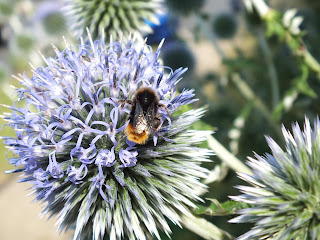
At the reserve entrance, I stopped to enjoy the Bumblebees that were visiting the flowers by the Ranger Services building. In the following pics, note the Tree Bumblebees (Bombus hypnorum). They have a distinctive fluffy ginger thorax (back), Black Abdomen (body) and a white tail. This species was first found in the UK, in 2001, but can now be found across much of England and south Wales.They prefer to nest above ground, using tree holes and unused bird nest boxes.



Cool, clear, misty start to calm glorious day
Mid-section - Compton to Newbridge including Compton Park and Barleyfield.
 |
| The Barleyfield at Dawn |
 |
| Start of a beautiful day |
A short sky-watch produced:
Black-headed Gull - 15 SW, 7 West
Lesser Black-backed Gull - 5 South
Jackdaw - 5 SW
Magpie - 18+ West ex roost
Greenfinch - 14 in from the North, with a few settling at the top of the Barleyfield, but most continuing SW
Starling - 2 SW
Chiffchaff activity was a lot quieter than last week, with 2 at the top of the field and 3+ near The Barleyfield Annex, where a small party of Long-tailed Tits were also noted. A Green Woodpecker called from just South of the crossings.
At Graisley Brook, near the Crossings, a Blackcap was calling and a Song Thrush flew out over the path.
At Compton Lock, a Goldcrest was singing and Coal Tits were calling from near Alpine Way.A male Blackcap was also there.
A young Buzzard was calling from Tettenhall Ridge and a Green Woodpecker was also vocal along Henwood Road.
The canal held a total of:
12 adult, 9 juvenile and a single chick Moorhen
13 adult, 10 advance juveniles and 8 chick Mallard (All the young were at Newbridge)
A Grey Heron flew South over The Paddocks.
At Newbridge c5 House Sparrow were present along with a calling Nuthatch in the beeches by the old bridge. At first it appeared that there were only 3 Swift over Newbridge, but as I got to the Paddocks, 20+ were seen flying high overhead between Henwood Road and the Ridge. They were observed for a good while and seemed to be a collection of Newbridge and Tettenhall birds, rather than passage birds.
2+ Goldcrest were in the station paddock and a family party of 5+ Chiffchaff were in the middle paddock feeding on umbel flowers.
At the Barleyfield, the number of bees and Hoverflies was impressive


I tracked back through the paddocks to head for a meeting with the Park ranger services. I had reported that we had lost a number of species from The Barleyfield in recent years and that the field would benefit from extending margins and leaving a small area (less than 6% of the total area of the field) uncut. This would allow insects to continue to feed after the mowing and would also provide micro-habitats for them to shelter across the Winter months and complete their life-cycle.These areas would also allow late flowering plants to flourish and act to reduce the level of disturbance to nesting and feeding birds.
As regular readers of this blog are aware, I have held a really positive view regarding the councils's attitude to conservation and the protection of the Valley and it's wildlife. Once again, I can say wholeheartedly that Leisure Services have acted in a really positive manner.
The Barleyfield is a very special part of Smestow Valley LNR, and the protection of it's wildlife, and the creation of new habitat and increased bio-diversity there will mean that it's long-term value and designation is protected.
In the main Paddock, I was surprised to see 2 Male Blackcap, 2 Chiffchaff and a Common Whitethroat, all feeding together on the umbel flower tops.
At the reserve entrance, I stopped to enjoy the Bumblebees that were visiting the flowers by the Ranger Services building. In the following pics, note the Tree Bumblebees (Bombus hypnorum). They have a distinctive fluffy ginger thorax (back), Black Abdomen (body) and a white tail. This species was first found in the UK, in 2001, but can now be found across much of England and south Wales.They prefer to nest above ground, using tree holes and unused bird nest boxes.
 |
| A newcomer - Tree Bumblebee (Bombus hypnorum) |


Tuesday, 6 August 2013
Update regarding developments in the vicinity of the Barleyfield and Compton Park
As promised, I have carried out some enquiries regarding any proposals for development of land along Compton Road, bordering the Local Nature Reserve.
There appear to be no planning applications submitted in respect of housing developments, and no consultation processes under way regarding any such developments.
Most of you will probably be aware of the press release that came out in May, but for ease you can find it at:
http://www.expressandstar.com/news/2013/05/17/college-site-future-in-wolverhampton-in-doubt-after-review/
One thing is clear though. Every visit to the valley of late has included enquiries from local residents who are opposed to any further developments in the Compton Park/Barleyfield area. There are certainly enough people with a common view that would provide a powerful voice, should any such proposals surface in the future.
It is a credit to the people of Smestow Valley, that they hold such a strong attachment to our only Local Nature Reserve. In a modern way of life that is so fast and cold, local residents value the opportunity to relax and enjoy the beauty and peace that the area brings. The strength of the bond that people have with urban nature reserves, serves to show that the vision created through Natural England was correct - contact with nature and protected open spaces is an important social requirement.
Everyone is asking the same question: with so many abandoned sites in areas of low value to nature and the public, why do we keep seeing developers along our green corridors????
Thank you to everyone that has shared their thoughts and concerns with me over the past few months.
Please email me at smestowsightings@gmail.com if you have any further concerns or information.
Sunday, 4 August 2013
Here's to black roosters, white
dancers and a grebe that got away
Dunstall Park, July 2013
Sporadic and brief visits to the racecourse during July in what is normally one of the site's quieter times, so perhaps a round-up is in order, a few snapshots of a month when migrants moved, the earth burned and butterflies danced.
Families of Canada Geese walk sedately across the central grass area as the heat increases mid-morning, the procession marking the end of one of their daily grazing sessions, the thirteen gosling now virtually adult-sized, following their parents to duck under and through a hole in the lake fence. The birds follow a path single-file through dried rough grass, down the earth bank, across the mud margins and under a burning sun they push out on to the water to rest and preen. Their relief at being afloat again is almost palpable.
Striking, alert, with black-moustache and azure wing-flash, an adult Jay sits, watching intently from a bush at the north western corner of the racecourse. Its attention suddenly drawn to an insect at the very tip of the branch, the bird hops forward and as its weight becomes unsupportable, delibrately falls to one side and drops, the insect flying up as the branch shakes. Already the Jay is climbing, describing an almost perfect circle against the bright sky to snatch its prey on the way back down. The bird settles on its original perch, and consumes its victim. A ten-second performance from a corvid to match a Spotted Flycatcher.
Two stripe-necked juvenile Little Grebe (fledged, from another site and present from mid-month) float together on the lake preening and washing, all is calm, a female Shoveler feeds in the shallows, adult and juvenile Coot are chugging to and fro, a juvenile Grey Heron stands hunched on the island, where House Sparrow feed in stands of rosebay willowherb and adult and juvenile Starling cluster, sunning themselves against a bank of bramble. An immature Lesser Black-backed Gull lands and floats towards the grebes. Sensing danger, one moves away as the gull lifts off and accelerates towards the sibling, its intention suddenly clear, but not to the grebe, which young and inexperienced sits motionless as its attacker homes in. The gull twists and plunges forward, its wingtip hitting the water, there's a splash as its bill seems to touch the smaller bird, but the grebe vanishes, crash-diving at the last moment and avoiding the fate of Mallard duckling, many of which were amost certainly taken in this way earlier in the summer. The gull shakes itself, straightens, climbs and moves off towards the city. No easy pickings this time.
The heat has been intense for days, but overnight thunderstorms are promised. It's mid-evening on 22nd, the air is still, the atmosphere close, as a flock of at least 50 House Martin, adults and youngsters from the nesting colony on the nearby Farndale housing estate, swarm around the tops of floodlight pylons near the grandstand and Barn Swallow track back and fore low over the grass near their stables breeding site. Three swallows perch in bushes by the edge of the lake, where a Coot still finds time to be stroppy, rushing past a single Green Sandpiper which stands motionless in the shallows (this migrant species has been dropping in at the lake throughout the month, with four birds seen on June 30th). A Stock Dove bends forward to drink from water so still it reflects the outlines of c.40 Lapwing clustered along the muddy margins, as a young Whitethroat flies from the base of a bush and disappears into the grass. Dusk approaches, so it's back along the tarmac strip towards the grandstand. More than 500 dark shapes are resting, preening or foraging, black against the scorched yellow-brown grass, most of them Crows and Jackdaws, with a scattering of juvenile and adult Rooks, all drawn to this pre-roost gathering. I leave before they do, clouds are gathering on the far horizon, the heatwave is ending.
The month is coming to a close, the storms have retreated, and at the lake it's quiet in the late morning. The two young Little Grebe are still present, 12 Lapwing fly up as a female Sparrowhawk flaps her way across towards the Farndale, and a Green Sandpiper picks its way along the shoreline. Flying low from the oak copse near the Water Bridge, an adult Buzzard gains height before moving purposefully towards Stockwell End, where it circles, drops and is lost to view. It's sunny and hot, but not with the intensity of recent days, long grass and thistles along the north western edge drainage ditches stirring gently in the warm breeze as fluttering shapes move through and low above them, butterflies dancing their way from one flower to the next, a sight which was missing last year in one of the worst-ever breeding seasons for their kind. Small Whites are here in abundance, with smaller numbers of Large Whites, Meadow Browns, Ringlets and Small Tortoiseshells. Two newly emerged Peacocks sun themselves, "eye" wings outstretched, perfect in colour and form (a female Common Blue was seen earlier over close-cropped grass by the lake, and in recent days Commas have appeared). A last look upward, slender white shapes are flicking and twisting against the bright sky, a flock of ten or more Black-headed Gulls fly-catching high over the lake, drifting towards the city as they follow the insect feast. Summer has a way to go yet . . .
(NB. Dunstall Park is a restricted commercial site. Access is strictly controlled).
Friday, 2 August 2013
Early Morning Barleyfield Watch
Thursday 1st August 2013
Dry after light overnight rain, set to be warmest day of year, cloud clearing from dawn, Light Southerlies
Barleyfield: 05:00 -07:00
My first dawn watch for months really was a great experience as Compton Park and The Barleyfield were alive with bird activity.
30+ Magpie were congregating around the back of the existing St. Edmunds Buildings.
On the pitches by meccano Bridge there were 115 Black-headed Gulls, including 10+ juveniles and 12 adult Lesser Black-backed Gulls.
My intention was to head to the top of the Barleyfield and start a skywatch for a short while. I knew it was too early in the year for visible migration, but I was still a bit inquisitive as to what would be noted, including a possible early movement of Swifts.
However my walk up the Western border became quite involved as I was amazed at the number of warblers that were around. They were literally everywhere and, without disturbance many were flying into the Barleyfield itself to feed on insects sheltering on the umbel flowers (parsleys and hogweeds):


The vast majority were Chiffchaff but I was surprised to see 2 juvenile Willow Warbler near the Barleyfield crossings, with an adult singing on the railway walk nearby. A territory had been maintained nearby, but I havn't been down often enough to monitor it.
Dry after light overnight rain, set to be warmest day of year, cloud clearing from dawn, Light Southerlies
Barleyfield: 05:00 -07:00
 |
| Barleyfield - looking East an hour or so after dawn |
My first dawn watch for months really was a great experience as Compton Park and The Barleyfield were alive with bird activity.
30+ Magpie were congregating around the back of the existing St. Edmunds Buildings.
On the pitches by meccano Bridge there were 115 Black-headed Gulls, including 10+ juveniles and 12 adult Lesser Black-backed Gulls.
My intention was to head to the top of the Barleyfield and start a skywatch for a short while. I knew it was too early in the year for visible migration, but I was still a bit inquisitive as to what would be noted, including a possible early movement of Swifts.
However my walk up the Western border became quite involved as I was amazed at the number of warblers that were around. They were literally everywhere and, without disturbance many were flying into the Barleyfield itself to feed on insects sheltering on the umbel flowers (parsleys and hogweeds):


 |
| Beware of Morning light!!! - looks a bit Willow Warbler due to strong light, but the black legs give it away - Chiffchaff |
 |
| Willow Warbler - longer wings and pale legs. |
The vast majority were Chiffchaff but I was surprised to see 2 juvenile Willow Warbler near the Barleyfield crossings, with an adult singing on the railway walk nearby. A territory had been maintained nearby, but I havn't been down often enough to monitor it.
I decided to attempt a count from the central scrub at the top of the Barleyfield down the Western border to Graisley Culvert and the area by Meccano Bridge. I counted at least 15 Chiffchaff (including two family parties of 5+). It was just so hard to tell whether these were all local birds or whether there was an element of early post-breeding movement involved.
The highlight of other sightings were 2 Yellowhamers, that were picked up by their calls as they headed low South over the top of the Barleyfield. I had seen a single Yellowhammer over this site on 9th August last year.
Other highlights were:
4 Starling SW
6 Greenfinch at the top of the Barleyfield, as numbers start to swell.
Green Woodpecker
Great Spotted Woodpecker
Coal Tit - by Compton Hill Drive entrance
3 Goldfinch
just one Common Whitethroat
4+ young Bullfinches
Wednesday, 31 July 2013
First Sand Martin for Compton Park Wetland
3+ House Martin over Compton Park Wetland. The results of what, at first seemed like an inadequate planting scheme at the new wetland now appear to be amazing, viewed through the security fencing. I really hope this area is maintained and policed in the future, because it really does look like a valuable habitat addition.Thanks for this has to go to the Wildlife Trusts for reminding developers that you cannot just walk all over mother nature!!!!
On the Barleyfield things were quiet so I turned my attentions to the world of insects!!
I am still on a steep learning curve in my bid to become a competent amateur naturalist, but as I keep adding to my knowledge, then my updates will be of interest to others who notice the wildlife of Smestow Valley as they enjoy their walks through the reserve.
First up- how to sex Red-tailed Bumblebees!! This is quite an easy one:
 |
| Large size and simple black coloration with red tail - a female. |
 |
| Much smaller and note the small amount of yellow in bands on the head and base of abdomen - the male |
 |
| Bees can be highly variable and this male is showing much more yellow around the head. |
However not much is simple in nature and if you look at the antennae on the following two pics of Skippers seen on the Barleyfield and Eddy's Alders, you will notice that they are highly variable!!! Anyone who has more experience in this area of the natural world, please email me your tips for field identification, as it's not quite as easy as it looks!!!
 |
| This example of Small Skipper is showing visible areas of Brown on the antennae |
 |
| This example appears to show all black antennae with no striping or definition at all!! |
To finish, here is perhaps the most beautiful insect you could wish to encounter on the Barleyfield. Its a type of Longhorn Beetle:
 |
| Strangalia maculata - in it's attempt to avoid being eaten, this species has evolved to look like a Wasp and in the process has provided us with a stunning insect to encounter on walks where Parsleys and Hogweeds grow. The larvae feed on wood so a nearby scrub or woodland edge is necessary for it to colonize a meadow. |
Dry calm and bright after days of intermittent storms and showers. Cooler (c20C)
A late walk to Compton village brought a couple of nice surprises.
First Compton Park wetland attracted 13 Swift 2 House Martin and a single Sand Martin, all swooping low over the water to feast on the insects which had gathered on such a calm evening. It will be interesting to see just how many Swift and hirundines we get here over the coming weeks as passage gets under way.
A young Green Woodpecker was also calling from the Wetland area.
A young Green Woodpecker was also calling from the Wetland area.
At Compton Rough a pair of Tawny Owl were moving slowly South along the railway line, just before dusk, having emerged from nearby.
Tuesday, 30 July 2013
Ever Decreasing Circles
I have just taken a break for munch and was reading the 2007 edition of "Where To Watch Birds WEST MIDLANDS" (Graham Harrison, Steve Coney, frank Gribble, Helen J. Griffiths, Jim Winsper. Published by Christopher Helm, an imprint of A&C Black Publishers Ltd).
I was pleased to see Smestow Valley was at the top of the list of just 6 areas in the Black Country, mentioned for birding.
But as I read the section covering our Local Nature Reserve I became saddened.
Firstly it mentions that "the outstanding feature (of Smestow Valley)...is the population of Willow Tits, which at around six pairs, is one of the largest in the region". Just 6 years on and we have only occasional sightings of Willow Tit in the valley, and the species no longer breeds here at all.
Just as disturbing is the fact that the publication mentions breeding Northern Lapwing, Skylarks, Tree Sparrows and Yellowhammers at Wightwick Fields. Today, all of these species have retreated from this end of the reserve into South Staffordshire, although singing Yellowhammers and Skylarks can be heard on the border from Castlecroft Bridge. Also vanished, are the Grey Partidges which are mentioned, and only the odd rare encounter with the commoner Red-legged Partridge may be enjoyed. Barn Owls have also now abandoned the reserve, bar rare Winter encounters.
Aside from the above species, the 2007 list for the Smestow Valley remains intact, though there has to be cause for concern for the future status of Kestrel, Little Owl, Lesser Spotted Woodpecker, Treecreeper and Reed Bunting.
Garden Warbler and Lesser Whitethroat, have a bare toehold as a Summer visitor to the valley now as well.
Passage migrants; Cuckoo, Sedge Warbler, Reed Warbler, Yellow Wagtail, Whinchat, Northern Wheatear and Spotted Flycatcher all have an ever-decreasing prescence in the Smestow Valley on Spring and Autumn passage.
It is so easy to pass all of this off by saying decline in species is happening all across Britain, so we cannot do anything at local level to prevent it. This is nonsence, as the success of so many schemes mentioned in the "State of Nature" report demonstrates. Nature's whole food-chain is under threat from weaknesses within it and we need to have strong, positive minds in order to turn things around.
The whole of nature is affected, not just birds. Does anyone know what plants, invertebrates, amphibians, reptiles or mammals have vanished from the reserve in recent years?
There is hope!!! The vast majority of species mentioned above remain on the valley's yearly sightings list. With good management, these can be attracted back into the valley, through the protection, enhancement or introduction of suitable habitat, where strong eco-systems can be built. These measures will also ensure that no further species become threatened or extinct in what surely is Wolverhampton's jewel and only Local Nature Reserve.
Through the efforts of so many scientists, naturalists and organisations, the U.K. appears busier than ever, trying to protect our natural heritage. However 70% of species remain in rapid decline. More effort, from some yet more decline - something is not right. We have to act as a nation of communities that care for nature and who understand it's fragility.
In it's recent history, this valley provided the template for management of urban parks in this country. Lets try now to show the steel of Black-country folk by setting an example to the rest of the U.K and showing that we have the strength to break the trend of these truly ever-decreasing circles.
Sunday, 28 July 2013
Sunday 28th July 2013
Dry and sunny after heavy overnight rain.
A quick bolt along the valley from Compton to Hordern Road produced:
Success for the Compton Pied Wagtails - A juvenile was with both parents on the upper playing fields by Meccano Bridge.
Also making use of the rain-soaked ground there were 3 Mistle Thrush and 2 Starling.
The Goldfinch flock at the North end of the Barleyfield had risen to 8 birds, all adult.
A Stock Dove was on the Compton Park Wetland.
Other matters:
Some blog members were experiencing problems opening the document I sent out. I have resubmitted this and would greatly appreciate feed-back from everyone as soon as possible please. Thank you for your time taken with regard to this matter.
There is a rumor spreading through the valley that The Barleyfield is under threat from development.I'm not sure whether this has stemmed from developments regarding "The Cedars" at Compton Road, but I shall certainly be getting the facts for everyone, when I visit the council later this coming week.
Anyone with information regarding such proposals, please contact me via smestowsightings@gmail.com
Thank you all
Friday, 26 July 2013
Note to Blog Members
Just a quick note for Geoff Russon, Angus Dickie, Ian Phillips, Gareth Clements and Kevin Clements.
I have sent you all some info via e-mail (to gmail accounts where applicable) and would welcome your views regarding the proposals.
Please respond using a reply email.
Thank you all
I have sent you all some info via e-mail (to gmail accounts where applicable) and would welcome your views regarding the proposals.
Please respond using a reply email.
Thank you all
Wednesday, 24 July 2013
Early Kingfisher Return to Mid-section of Reserve
Andy, a local resident has just reported that he saw a Kingfisher on Smestow Brook at Prefab Weir on Sunday 21/7/13 at 8:30pm.
This is quite an early return sighting for a species that nowadays leaves the valley to breed each year, so extra special thanks for sharing this encounter.
This is quite an early return sighting for a species that nowadays leaves the valley to breed each year, so extra special thanks for sharing this encounter.
Subscribe to:
Posts (Atom)